-
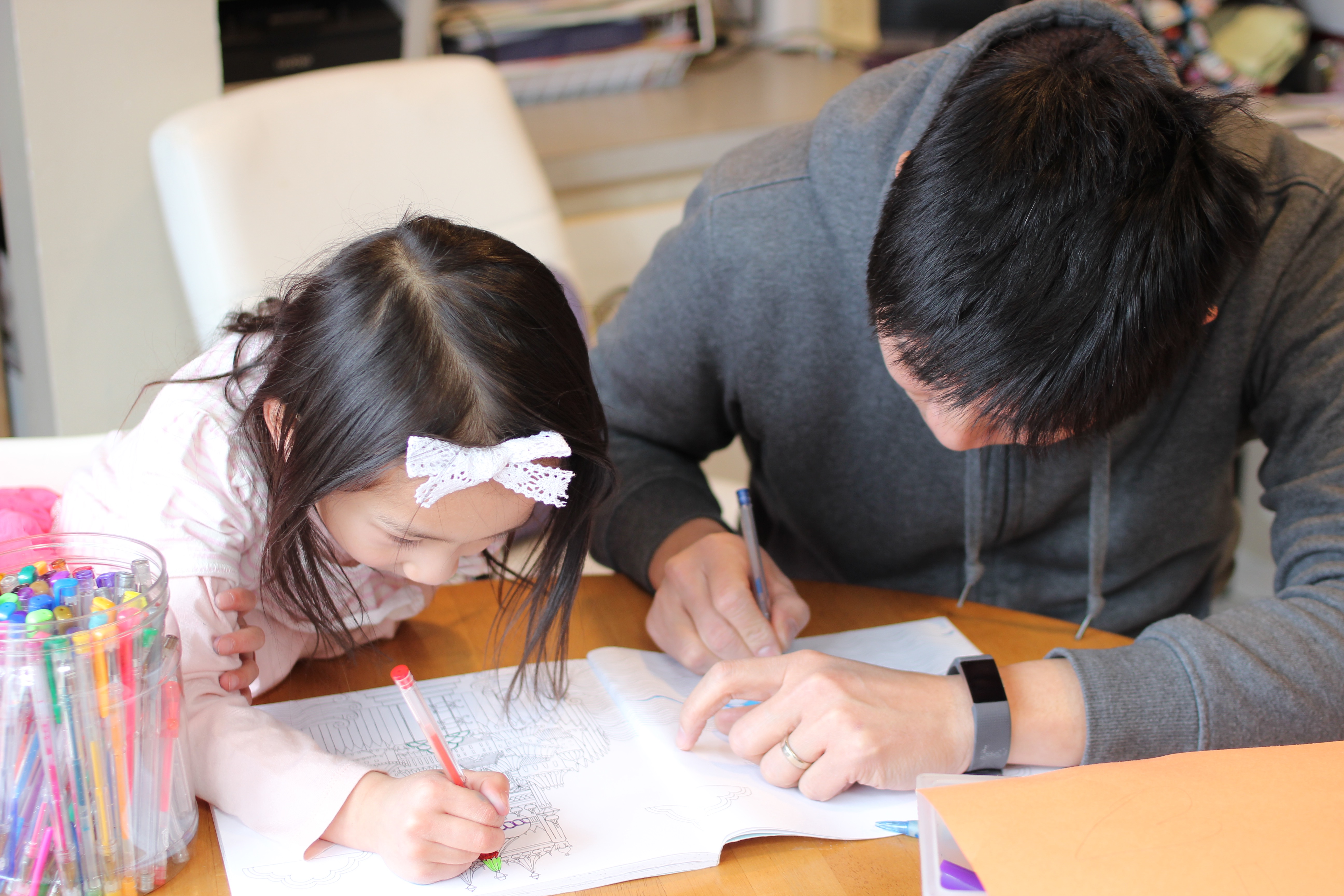
Overheard today—
Jeff: You’re a very pretty girl!
Daughter: I know.
Jeff: How do you know?
Daughter: Because you tell me!Not too long ago I had another conversation telling one of our girls why she was so special to me.
Her: Why are we talking about this?
Me: Do you want to talk about something else? Like why your brother is special?
Her: Yes!I told a friend recently that growing up I was never insecure about my looks— even with big glasses, braces, and no sense of style. I attribute it to 1) not having TV, teen magazines, or Instagram. And 2) having a dad who told me I was beautiful. Dad told me this enough that I took it to be true. Then I didn’t even need to think about how I looked, pretty or not.
Every day we are presented with visions of beauty, aptitude, talent. As we scroll and scroll, we are lured into judging. To comparing. Then we filter and crop our lives to size. We forget we are image bearers, that God lovingly designed us with our builds and heights and hair. With our talents, gifts, and passions.
In Christ, our Father removes us from the slippery slopes of comparison and places us on level ground. You don’t need to earn his approval. You don’t need to compare. You don’t need to hold yourself to the world’s standards. And from this place of security, you can walk on.
Not to self-esteem boosting, mirror pep talks, and self-love memes. But to serving others. To neighbor-love. To God-glorifying stewardship.
Today, let your Father tell you what he thinks of you. Believe him. Let him free you from insecurity until you can forget yourself. And then move on to greater things.
Like listing all the reasons your little brother is so special.
-

It hit me over Tex-Mex after a doctor’s appointment last week. I paused from my burrito, looked at Jeff and said, Can you believe we are going to have 4 kids? Can you believe we have 3?
I’m 37 weeks pregnant and baby girl could arrive any time. My doctor jokes about how I’m a “pro” going into my fourth labor and delivery, but the truth is, I don’t feel much more prepared for this baby than I felt 7+ years ago. If anything, three kids deep, I feel less sufficient for the task. Weeks (or days) away from meeting our fourth, I don’t feel as capable as I might have thought I’d be by now.
It’s not just the number of kids, really. (Though when I was pregnant with our first I couldn’t imagine how people made it past one.) I remember being discharged from the hospital with our firstborn and thinking, “That’s it? They’re just going to let us take her?” That we are allowed to be parents at all is still as shocking to me. As a mom of three, the enormity of the task of motherhood continues to dawn on me daily in new ways as does my inability to carry it out as I ought.
There is much more mystery in parenting than I had anticipated. I never expected to always have the right answers, to know what to do at all times, but I don’t think I ever realized how incredible it would be to be firsthand witness to a child’s life. As parents, there’s no one else who knows your children as well as you do and it’s easy to start feeling like you’ve got them figured out. At the same time, there is so much we are still learning about our children, so much hidden in the depths of who they are that we are only beginning to see.
It’s not just that each child has a unique combination of personality and preference, strengths and weaknesses. It’s been fun to watch these aspects of their personhood be revealed, to learn who’s good at what, to be able to anticipate their different responses to circumstances, and to know how to help them differently. But there is a deeper reality that has become more apparent to me these days. That is, the fact that my children are daily interacting with the world— and with me— as embodied souls.
It’s not that I didn’t know this before, that my children have souls, but the reality of it is becoming increasingly evident to me. I see it as we talk and they give me insight on how they interpret the world. I see it as they struggle to do good, as they grapple with their fears. I see it as they become aware of the brokenness in and around them.
I see it when one of them calls from the bed, “Mom, I have a question— it’s a Bible question!” It turns out she doesn’t just want to know some facts from Scripture, but what to do with her knowledge of falling short of God’s standard. We sit and talk through how difficult it is to be sorry and how hard it is to forgive.
The whole day, I have interacted with her primarily as caretaker and in-charge momma, now we speak as fellow struggling sinner-saints. We talk about how Paul wrote about the waging war inside us, of not doing the good he wanted to do, of doing the evil he didn’t want. I struggle too, I tell her, and we will continue to until we see Jesus. But he forgives us. He can change us. “I think I get it now,” she says sweetly. We hug and say goodnight. I have not been granted a chance to hear her thoughts and feelings, I have been gifted a chance to glimpse the inner workings of her soul.
My children are immortal beings with eternal souls. I would say this takes my breath away, but I don’t want to give the wrong impression. It feels less like witnessing a pretty sunset at the beach and more like standing at the precipice of a mountain. The view is incredible but my sense of helplessness at the top of sheer rock is almost overwhelming. To be entrusted with the care of souls is beautiful and terrifying at the same time. It is a holy task.
When I spoke to my daughter, we weren’t just interacting as thinkers. I couldn’t just operate out of my knowledge of religious truth, philosophy, or child psychology. Parenting is soul work. As she tried to make sense of what she knows and feels to be right, her own experience of being unable to carry it out, and her fears about the implications of her failure, her heart was making sense of truths with eternal consequences. My children are daily learning to live their lives before the face of God, of the reality of sinful nature, and hopefully, learning the wonder of the gospel.
Thus it is with fear and trembling that I prepare to welcome our newest family member into the world. I am not a pro. I could never wear any motivational mom gear because I am not #momstrong or a #bossmom by any measure. I don’t say this just because I know I should, but because I feel my own insufficiency more deeply and the weighty task of caring for these souls to be increasingly heavy. Yet I think there may be one thing I dare say I have grown in since not-so-baby-anymore #1, and that is turning to the one who is sufficient.
Many years ago, I may have crumbled into discouragement and fear at this growing sense of the enormity of motherhood, but by grace, I am learning to lean on grace. I have grown a bit, I hope, in running more quickly to my eternal refuge and help, to the one who welcomes weak moms and those who feel like they don’t know what they’re doing. I am recognizing more quickly that as I start feeling like panicking from the heights, that this is a call to trust. It is a call not to dwell on my lack but at his willingness to give grace, to finish my declaration of weakness with James 4:6’s but he gives more grace.
I have found there are one of two great temptations we are faced with when standing before tasks too great for us. First, the world would encourage us to turn inward at this point, to self-help and positive hashtags. But many of us have fallen enough times into the foolish self-confidence of Peter, who after declaring that he was different than all the other disciples, that he’d never deny Christ, found himself weeping at the end of the night. We have had enough of our own declarations of strength and subsequent failures.
The second temptation though, when we find ourselves trembling, is to try to pass off our unbelief as humility. Just as as soon-to-be-king Saul hid among the luggage even after God made clear his calling, we may walk in something that looks like humility, but actually is unwillingness to trust in his grace.
We, however, are called to a third way. To declare as Paul did, that though we are weak, our God is strong. As Christians we are freed not only to admit, but boast in our weaknesses and hear our God declare the sufficiency of his grace over us. His power is made perfect in our lack, so we stand confident in the strength he promises to give us to face the tasks he calls us to. Whatever your particular temptation in the face of God’s calling, know this — God gives more grace. He delights to show himself merciful to the humble and needy, and when you turn to him in your weakness, he receives glory by showing the sufficiency of his grace.
So here I am, in the last stretch of pregnancy, still learning to trust God with the life of my baby. Only instead of just wondering whether her heart will beat until we hold her in our arms (which I still grapple with anxiety about), I am trusting God for grace to care for her soul and the souls of her siblings.
I don’t know what you are being called to these days, whether it’s parenting or something else, but I do know that our sense of inadequacy and insufficiency often serves to remind us that God calls us to holy tasks too great for us. Maybe the reason why your particular task seems so huge is simply because it is huge. To live in obedience to God, to love as he loves, to trust and obey, to persevere through suffering– these are no small things whatever the context.
Whether in church, work, friendship, or family, we need not be strong on our own. We need not cower because of our inability. Though we may stand trembling at the precipices of God’s tremendous calling for our lives, we can trust. Fully aware of the beauty and enormity of the tasks he has granted us, we look to him. Truly, our tasks are great and we really are insufficient for them, but even so, he gives more grace.
P.S. I’ve been away from the blog for a while because I’ve been working on another writing project– but I hope to be posting more regularly again! They’ll probably be shorter posts so I can get them out more often, but hopefully they will be still be helpful.
P.P.S. At the advice of a friend, I’m starting an Instagram account for this blog that I plan on using more regularly. If you’re on Instagram you can start following @keepingheartblog.
-

“You’re so proud.”
Such were the insightful words of a dear, straightforward friend after I shared about my time in prayer. More specifically, I told her that I had told God, “My heart hurts…a little.” It was pretty big for me to admit out loud, to God and to another person, about my heartache. But she was referring to my attempt to play down what actually had hurt quite a lot. I laughed because she was right, and more than 10 years later, I’m thinking again about what she said.
Ever since I was a kid, I prided myself in not making a big deal out of things my peers did. I probably thought of myself as more mature, saving my sympathy for things I thought were real problems, not boy or friend drama. There were so many people going through worse things, how could my friends or I complain about our lives? I don’t know what it was that made me start comparing people’s difficulties so early on. Certainly pride was a factor, though I think not the whole reason.
Part of comparing people’s suffering had to do with trying to make sense of the world. As a child, I was moved by reports of famine abroad or serious illness closer to home. I didn’t know how to reconcile such terrible suffering with less horribly difficult things, and I didn’t think I should make a big deal out of my relatively easy life. I knew God was involved in our day-to-day, but I couldn’t see him as sympathizing with our daily burdens. Not when there were so many others who suffered more. Not when he himself already had gone through so much for our salvation.
The moment more than 10 years ago when I admitted that my heart was hurting (albeit, toned down with “a little”) signified a breakthrough for me in learning to come to God with suffering that in my mind was insignificant but felt hard nonetheless. As I started to give God just a little leeway into my hurt, he broke through in compassion with words Jesus spoke at the famous feeding of the four thousand.
The story goes like this. After days of ministering to the crowds, healing the lame, blind, crippled, and mute, Jesus approaches his disciples about getting food for the people. The disciples protest the impossibility of this task, and Jesus performs a miracle, feeding four thousand plus with seven baskets of leftovers to spare. I had known this story since I was a child, but for the first time, I noticed Jesus’ motivation for multiplying the bread and fish.
“I have compassion on the crowd because they have been with me now three days and have nothing to eat. And I am unwilling to send them away hungry, lest they faint on the way.” (Matthew 15:32 ESV)
Jesus, who’d fasted for forty days early in his ministry, was concerned about a crowd who hadn’t eaten for three. He didn’t compare his capacity and trial to theirs. He knew some of them would not be able to handle the journey home, and in his kindness, was unwilling to send them away empty. He didn’t say, “I’m doing important things like healing blindness and sickness, bringing about God’s kingdom. You find food on your own.” He didn’t harshly rebuke them, “I didn’t eat for forty, you should be able to survive three.” He had compassion on them, the Scripture says. In the same way, he has compassion on us.
A few weeks ago, I told a friend how tired and unmotivated I’d been feeling. I wouldn’t have minded the fatigue if my mind were sharper and soul healthier. If I were out of commission physically, at least I could be getting some reading or prayer in. But I was reminded again that try as I may to separate the parts, I am an embodied soul, and my body, mind, and spirit are interconnected in complicated ways. My lack of productivity, both outwardly and inwardly, contributed to low-level guilt. I was also tired and cranky. And I was frustrated that I was being knocked out by something so common— a healthy first-trimester of pregnancy.
Then she spoke words I believed were from God to my heart. “Just because it’s common doesn’t mean it’s not hard.” (Thank God for kind friends who speak truth!)
So I have been thinking again of the gift of approaching God with our common, hard things, and want to share some of what I’ve been learning.
Common, hard things remind us of God’s infinite mercy and power.
If God were finite, he’d need to split his time, attention, and power accordingly between global crises and individual personal requests. The news cycle and “compassion fatigue” reveal our limited human capacity to care, much less act, in response to the suffering we witness in the world. Oftentimes we assume that God is like us, triaging the needs of billions and prioritizing the urgent ones first.
Some people think going to God with the small things in our lives belittles him, making him small in our own eyes. This is true if we only ever go to him with our own wants and needs. But our heavenly Father is big enough to handle both requests for his kingdom to come and for our daily bread. He is powerful enough to shoulder our troubles and the burdens of the rest of the world day in and day out.
I’ve heard people say they don’t pray because there are so many other important problems in the world for God to tend to. I know what that feels like. Often, God provides in small ways that matter to me, and as I’m thanking him, I am embarrassed that he answers my “dumb prayers.” I’ve been trying to stop calling them “dumb” and instead think of them them as “sparrow” requests, granted by God who cares for lowly sparrows and numbers the hairs on my head (Matthew 10:29-31).
Because God is infinitely powerful, no burdens are too heavy for him. Because he is infinitely merciful, none insignificant. He knows our frame, knows when there are things that will leave us too faint to walk home, and is willing and able to provide the bread and fish we need. Learning to come to him with our common, hard things reminds us of the greatness of his compassion and the limitless of his power.
Common, hard things deepen our sympathy for others.
There are trials we all recognize as legitimate suffering— serious illness, death of a loved one, persecution, and the like. But it’s harder to minister to people when they are not as strong as we are, not “getting over” things as quickly as we would, not enduring with attitudes we think they should have. We grow impatient with such sufferers. The problem with having a measuring chart that relativizes our suffering is that it hinders us from ministering to those whose trials are deemed less difficult. Thankfully, Jesus is not like us.
Jesus endured all we face: loneliness, rejection, temptation, pain, loss, tiredness, and more. He knows all of it, from Everest-sized suffering to pebble-in-shoe trials. Yet he doesn’t wait for us to approach him with our problems only to respond, “I endured. Why can’t you?” Rather, because he was tempted in every way as we are, our High Priest mercifully sympathizes with us in our weaknesses (Hebrews 4:15).
Likewise, as we learn to admit to God that the common trials in our lives are hard, we no longer see ourself as better than others who suffer. And as we receive comfort from him in our trails, we are able to comfort others with his divine comfort (2 Corinthians 1:3-4).
Common, hard things humble us so we can receive grace and give him glory.
Marriage and parenting are God-given mirrors, revealing to ourself our true selves. Since becoming a parent, I’ve seen how impatient, unmerciful, unkind, and all-around nasty I can be. But the most humbling thing for me hasn’t been merely seeing how sinful I am. The most humbling thing has been realizing how I’ve pridefully judged others who I thought were impatient, unmerciful, unkind, and all-around nasty. If my trials were uncommon and suffering extreme, I may find a way to excuse myself. But being put through the daily, common grind and temptations others face— and failing. That has been humbling.
The common, hard things in my life have been used by God to surface pride in the ability to resist temptations I thought myself above. I didn’t think I’d be the mom with the kid screaming in the store, caring more about my image than my child. Until first trimester of this pregnancy, I didn’t understand the temptation to distract myself with entertainment on my smartphone. I didn’t think my ability to be reasonable and patient was so rooted in my good health until facing constant fatigued and nausea. And I didn’t think there was so much pride and judgment sinisterly lurking in my heart.
1 Peter 5:5 says that “God opposes the proud, but gives grace to the humble” (ESV). It is scary to think about being opposed by God. But the child of God has great comfort in knowing our Father works to humble his children. He disciplines us not just for the sake of putting us in our place, but that he may give us grace: grace in forgiveness, grace in his provision for our needs. And as we receive his grace, he receives all the glory.
When we don’t think we need him in our day-to-day, common, hard things, we miss the gift of his nearness, care, and forgiveness. When I push through ministry, family, friendship, and pregnancy on my own strength, I miss out on a chance to receive the grace of God and display his power being made perfect in my weakness (2 Corinthians 12:9). I miss out on the opportunity to show those around me that anything good in me comes not from me, but from Christ.
Our infinite God joyfully welcomes not only his strongest saints, but lovingly carries the weakest of his fold. So I’m hoping to learn to come to him more readily with my feeble heart, mind, and body. I am hoping that together we’d receive help to endure things we feel only ought to hurt “a little” and that we’d help others do the same. All so that ultimately we’d be witnesses to the boundless compassion and power our loving Heavenly Father.
-

When all around my soul gives way, he then is all my hope and stay.
– My Hope Is Built On Nothing LessWith anxiety as my lifelong companion, I have felt at times that I am the worst person to be pregnant. Each pregnancy has been emotionally tumultuous, even the three that were smooth by all other measures. So recently, when I saw that second solid line fade into view, I dropped to my knees on the tiles of my bathroom floor, less so out of joyful gratitude than desperation.
Pregnancy tends to put to the forefront one of my greatest fears: death of someone I love. As a child, I was often afraid if my parents were out of the house for long. It wasn’t so much because I missed them, but because I imagined them never returning because of an airplane or car crash. As an adult, I’ve needed to consciously silence unfounded worst-case scenarios when Jeff’s taken longer than expected to come home. As a mom, I’ve gone to bed praying my perfectly healthy children would wake up the next day. My fear supposedly dates back to before my memory, when I would interrupt my mom’s naps to make sure she was alive.
A well-meaning phlebotomist who, drawing blood to test for hormone levels during my miscarriage a few years ago said, “You’re still young, you can have another.” But he misunderstood. The pain of miscarriage was never about my hopes for a child per se. It was about losing one I already loved. You don’t have to have known your baby for long, or even ever held him or her in your arms, to have loved fiercely and deeply.
The pain of childbirth– not just in labor, but in broken bodies and miscarried babies– reminds us this world continues to groan under the curse of sin. We are warned against public announcements of pregnancy during the first trimester because of the sheer statistics on miscarriage, a staggering 20% of all pregnancies. We fear rejoicing over the tiny lives forming in our wombs, because, what if we’re that one out of five? Pregnancy after miscarriage can be especially harrowing. During a time that ought to be joyful, we are woken up in the middle of the night by bloody nightmares and lie awake wondering if they will become reality. Our hearts drop at each sensation that resembles symptoms of pregnancy loss.
Christians are not spared from miscarriage, stillborn babies, and sick children. We know we have a Father who hears, but for reasons that are good and kind, allows things to happen to us that don’t feel good and kind. We know the answer to, “Your will be done” may sometimes mean our wills aren’t. So in the end, what difference does it make? What difference does it make to be a child of God in a fallen world, full of legitimately scary outcomes, as we await the renewal of all things?
Against convention, Jeff and I shared with our church about those double solid lines as soon as we saw them. I understand not everyone chooses to do this. But these brothers and sisters have walked with us through one miscarriage and I couldn’t imagine walking through 12 more weeks of uncertainty and anxiety on my own. I needed to let them know not in spite of, but because of the possibility of miscarriage.
These dear ones have been sharing in our family’s joy in ways that, because of fear, I have not yet been able to feel. They have reminded me to rejoice at the news of the tiny one being fashioned within me, and they are praying for us both. Whether they will celebrate with us when God answers their prayers for a healthy baby or mourn with us through the grief of loss, I am unspeakably grateful for the gift of God’s people.
The present trial of the unknown, of being in the waiting, has at times made me feel like I am going crazy. It isn’t so much the irrationality of my thoughts, but the sheer volume of them and the breakneck speed with which they overtake me. It has been a blessing to be able to share this struggle with others who are praying with us. This privilege is only surpassed by the divine invitation to pour out my own heart to he who hears and helps.
Ours is a God who does not sleep nor slumber (Psalm 121). Who receives our cries at one, two-thirty, and four o’ clock in the morning. Ours is a God who harkens to pitiful, groaning prayers from bathroom, closet, and living room floors. He is merciful. He is with us. He has carried us from our mother’s wombs and will carry us even as he fashions precious babies in ours (Psalm 139).
This may seem morbid, and maybe it is, but I have often leaned my ear on the chest of a loved one only to pull back in sadness. Something about the physicality of a thumping heart reminds me of the inherent weakness of human life. Each ba-bum speaks to me of our frailty– our utter dependence on one aging, fleshy pump in the earthy, mechanical processes of our circulatory systems.
In a broken world, our hearts threaten to fail. They threaten to stop beating so that our spirits are given up. They threaten to break into a thousand pieces under the weight of grief. Regarding our weak flesh and breakable hearts, the psalmist cries out,
My flesh and my heart may fail,
but God is the strength of my heart and my portion forever (Psalm 73).My flesh and my heart may fail. This is not what I want to hear. I want assurance of a healthy baby and smooth pregnancy. I want to know the baby’s heart will beat and that my heart will not break. But the truth is my baby’s heart may continue to beat for years and years to come, and it may not. My heart may be filled with joy or it may be overcome with sorrow. The truth is, it feels as if my heart may already be failing under the weight of the unknown. But in the uncertainty, God is. God is the strength of our hearts. He sustains each beat. He will lead us, whether through the shadow of the valley of death or by green pastures with quiet waters. He carries us even in our anxiety as we await being led to valley or pasture, which one, we don’t know.
A story attributed to Robert Louis Stevenson takes place on a ship out at sea. During a terrible storm, the passengers are understandably terrified. One of them, against orders, sneaks out onto the deck. There he sees the pilot, calmly and steadily steering the ship. The pilot turns to the trembling man and smiles, at which point the man returns to the other passengers. To them he announces, “I have seen the face of the pilot and he smiled at me. All is well.”
All does not always feel well. I am still being tossed about, it seems. Still the knowledge that God is not dictated by statistics, superstition, or formulas in dealing with my life has been a steadying anchor as I’ve been tossed about by fear. As the fog of fearful outcomes obscure my thoughts, he speaks clearly, “Lean not on your own thoughts. Trust in me.” (Proverbs 3:5). I have been reminded it is not only the tiniest member of our family whose every day is granted by God, but mine as well. And while this truth has not quelled the storm, it serves as a ballast when I fear my sails are about to go under and feel I will be swallowed up by the deep. All does not feel well, but in the deepest sense, it is.
I know I am not the only one in the waiting. These past weeks have felt like months, and the stretch ahead of me, endless. I write for me, but also for you, dear ones, who face uncertain futures with trepidation. To remind us we are led by a kind and wise Captain. He is steadfast at the helm. Though we venture into the unknown, he turns his face to us. We may still be afraid– I am. Very, very, very much so– but we, the people of God, trust not in the strength of our own hearts to carry us through.
This week, we received the gift of seeing a tiny heartbeat on an ultrasound screen. We are still very early in the first trimester, so early in fact that the doctor had trouble finding signs of anything going on in my womb. Yet there it was, the answer to one prayer, uttered hundreds of times, for a heartbeat.
We are still not “in the clear” (though, when are we ever, really?) and still, convention would dictate not sharing this news of burgeoning life within me. Yet, I am in wonder of this tiny heart. It has only just started to pump, and whether for days or decades more only God knows. Whatever the case, each beat will be sustained by our good God until this precious one sees Jesus face-to-face.
Whatever the case, he must be the strength of my heart as well.
-

“To know Him is to love Him, and to know Him better is to love Him more.”
A. W. TozerOne of the sweetest moments of the day is when Jeff comes home from work. Sometimes, the girls catch the sound of his car door closing or the narration of an audiobook as he approaches the house. Other times, it isn’t until he steps in that they realize he’s back and run to see him. Either way, Jeff is usually met by two breathless little girls yelling “Daaaaddy!!” and a toddler boy excitedly jumping around in the fray. You’d think they haven’t seen him for days the way they greet him.
Our kids know their dad.
They know the sounds of his going out and coming in, and his form through the beveled glass of the front door. (Only once did one of them mistake someone else for him in her hurry. The stranger, whose build approximated Jeff’s, was met with the door swinging wide open and immediately slamming in his face.) They know that when he gets home, he’s happy to see them, ready to hear about their day.
On the flip side, sometimes Jeff has a hard time getting out because a little person is hanging onto his legs, refusing to let him leave for work. Sometimes there are tears because there was no proper goodbye. Our kids love their dad and would be with him all the time if they had the choice.
Those who have walked with me know the burning heart-question which drove me to seek God with intensity in my late teens. Seeking God’s will for my life led me to the Greatest Commandment, which in turn led to the perplexing question of: What does it even mean to love and know God? Growing up, a common saying in church highlighted the difference between knowing about and knowing God. But I wasn’t so sure what that actually looked like in the flesh.
In college, the words of the Apostle Paul set a clear course to aim for, a request to God to make this true of me: that I may consider all else as loss compared to the surpassing greatness of knowing Christ Jesus my Lord. God revealed himself as holy in the Scriptures. And the Spirit, in love, relentlessly shone a spotlight on my heart, revealing the ugly, pervasive grip sin had on me. Every time I tried to untangle one root of sin, I seemed to unearth more of my wretchedness. Finally, having been stripped of all illusions of my own righteousness, I saw— and felt— the beauty of the gospel with life-changing force. Oh the joy of not merely acknowledging, but knowing my sin and the grace of God through Christ!
The following years of zeal and service revealed significant gaps in my knowledge of God. Personal piety and ministry experience did not answer questions I had about reading and applying the Scriptures; my (mis)understanding of the Christian life led to guilt and burnout.
It wasn’t as if all I believed before was untrue, but I needed deeper and wider roots. While the foundation remained the same, God reworked some of the infrastructure of my theology through seminary. Rather than dryly academic, my studies in seminary were absolutely life-changing in the best way. I remember holding back tears and stepping out of class during breaks to praise God for his precious truth. And to this day, I am passionate about orthodoxy because I have experienced firsthand the way our thinking about God affects our lives before him.
Both experiential knowledge of and rigorous study about God have powerfully shaped my life and I now see the “knowing about God versus knowing God” dichotomy as a false one. People may tend toward cold intellectualism or vapid emotionalism, but knowledge about and of God is neither. Christians love God with all our hearts and our minds. God seeks worshippers who worship in spirit and in truth.
These days though, I have needed reminders to seek to know God relationally. In particular, I have been challenged by the psalms. Packed with rich theological truths about God and deep affection for him, verbs of religion and devotion abound— long, love, yearn. They are directed relationally— I remember you, seek you, faint for you, thirst for you, bless you, cling to you. Your steadfast love is better than life, the psalmist declares, so my lips will praise you (Psalm 63).
Scripture is packed with experiential, emotional, and relational language when it comes to us and God. Christians audaciously call God our King, Father, Creator, Redeemer, Shepherd, Friend, and Bridegroom— all descriptions of who he is in relationship to us— and ourselves his servants, children, creation, redeemed, sheep, friends, and bride. So I have been reminded to go to God with love and affection, to pray with words of the heart and long for deeper experiences of him.
At home, I have three living displays reminding me of the kind of knowledge at the heart of Christianity. Their knowledge of me, their mom, and of their dad is not abstract. Rather, it drives them to seek us for empathy and bandaids when hurt, to confession and requests for prayer when troubled. Their knowledge that we are wiser means they ask us many questions. Their prior experiences of our care means they climb onto our laps for snuggles just because.
Our kids are still growing in their knowledge of us and we of them, but there are countless ways they display what they already do know. The girls know where to go with fears about the night and joyful stories of new accomplishments. They come to us in tears, ecstatic, and everything in between. Our 18 month-old cannot articulate why he trusts us so much (as of now, he can’t articulate much at all), but he knows to cry for help when he’s slipped trying to reach the sharpener, even as his hand grips a dangerously sharp pencil and his legs dangle off the table. He knows to plead his case, “Mama!”, with pointed finger when his sister is walking away with the Mozart Magic Cube he was playing with first.
Our kids pursue us in relationship, excitedly chatting away, sitting close, freely offering kisses, hugs, and high-fives. They have come to know us through trusting us and they trust because they know us. They know about us, they know us, and will continue to know us more.
Their example is God’s grace to me. The little hand that grasps my finger to walk me to the snack cabinet reminds me to go to my Father because I know he is wise and able. Their desire to know where I am at all times, a reminder to seek him because I was made to be with him.
Every day, they give testimony of the loving delight of knowing in the scramble to the door, the jumping up and down, and the bursting laughter of welcoming daddy home.
God, make this true of me.
-

“We’re buying Todo lo que un niño debería saber sobre Dios?” Jeff asked me the other day as he looked over my shoulder into my online shopping cart. We’d already owned Everything A Child Should Know About God in English– the only language I can read in. I defended myself, “It’s only $6! I’m sure we can find someone to give it to!” He laughed a bit at me and we now have two copies of the book sitting on our shelf as I look for Spanish-speaking children to gift it to.
Some people are always in ready position when it comes making recommendations about restaurants or coffee or entertainment or fashion. My friends know I jump at the chance to recommend Christian books, blogs, and sermons. This is not because I’m extremely well-read (quite far from it), but because I have seen the impact of well-articulated, truth-filled content on my mind, life, and worship. I am always excited to connect others with voices God has used to shape and strengthen me. Plus, I have inherited the habit of buying bargain books in bulk from my mom.
As one way to pass on great content, I am starting this series– Yes, I recommend! where I’ll periodically answer one of my favorite questions: “Do you have any recommendations for books/blogs/etc. on…?” These lists will be short and by no means exhaustive– I’m not even claiming to include the best out there– but will contain content I’ve found helpful. I hope you will find some resources here that edify you too.
…
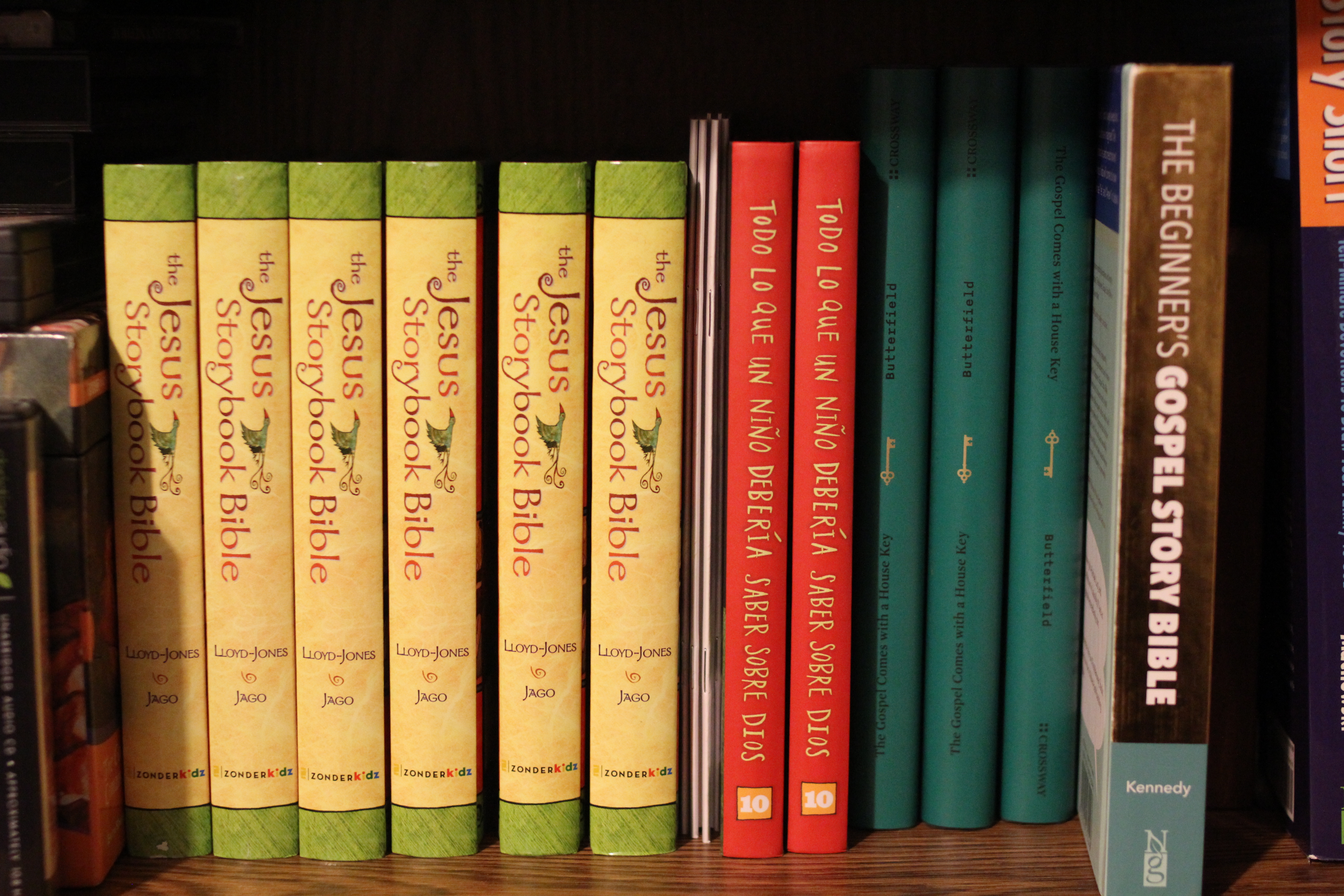
For the first post in this “Yes! I’d Recommend” series, my favorite books to give away: Children’s Bibles!
Some of you may be Christian parents or children’s Sunday School teachers. As parents, we have been given the divine charge to bring up our sons and daughters in the wisdom and instruction of the Lord. Teachers have been entrusted with the difficult task of explaining big Biblical truths in simple ways for young minds. Central to fulfilling both callings is helping children know God’s word.
In Deuteronomy 11:19 (ESV), God says:
You shall teach [these words of mine] to your children, talking of them when you are sitting in your house, and when you are walking by the way, and when you lie down, and when you rise.
And in Psalm 78:4 (ESV),
We will not hide them from their children, but tell to the coming generation the glorious deeds of the Lord, and his might, and the wonders that he has done.
Talking with children about who God is through the Scriptures doesn’t have to be complicated. It isn’t meant to take place only in serious, special settings, but most often happens in the day-to-day grind of daily life. As we walk, talk, sit, lie, and rise, we are given opportunity to teach his words and tell of his deeds. And as you teach your children or students, you will likely be astonished at how much they understand as they receive God’s truth with precious faith.
In our home, we do Bible reading with the kids at night. Bedtime is what works best for us for now, and usually they read with Jeff, sometimes with me. Then, we pray together– I sometimes ask them to list what they want to praise God for (“God, you are…”), something they’re thankful for, and something they want to pray for. Sometimes Jeff or I pray aloud for them. Other times we all pray at the same time, or we pray and they repeat after us. Admittedly, we sometimes skip days or rush through, but I pray God is planting the seed of his Word in their lives which will bear fruit in years to come.
As adults, we often read the Bible piecemeal and forget that it is a gripping, grand narrative. We may fail to take time to read slowly or engage our imaginations. In doing so, we miss the impact of Biblical narratives which don’t just tell, but display to us the wonder of God’s power, the irrationality of our rebellion, the horrors of sin, and the beauty of our long-planned-for salvation. Reading to children of the “glorious deeds of the Lord” is good for our souls as well as theirs.
If you’re in the market for a children’s Bible, here are our family’s favorites in order of age/ reading level.
1. The Big Picture Story Bible (WTS | Amazon)
This was our go-to for many years because of the short text. Even at 2-3 years, the kids could sit through it, enjoying the big pictures. The book traces the theme of God’s Kingdom– his place, people, and rule– from Genesis through Revelation, showing how Jesus fulfills God’s promises as Savior and King. At two, before she could talk much, I would sometimes find our daughter flipping through a Bible saying “fwaioehgjkadlksj Sarah salihgdafoiquwr Abraham,” and I think it was from reading this storybook Bible. Our church also uses this book for teaching younger children, but it’s good for older kids too to get a grasp of some big Biblical themes.
2. The Beginner’s Gospel Story Bible (WTS | Amazon)
This is our newest addition, and we’re reading this during our homeschooling time. Each Bible story has one main highlighted point and one question to discuss. It’s great at presenting Scripture’s stories in ways that inform both children’s knowledge of who God is and how they are called to obey him– i.e. right thoughts of God and right living before him.
3. The Jesus Storybook Bible (WTS | Amazon)
The power to obey God does not come from knowing his laws, but knowing him. The Bible stories in this book, with their amazing illustrations, point to Jesus in every text. In seeking to make these connections to Christ, parents are helped to resist the temptation to turn Scripture into a book of morals. It is refreshing to see our children learn to understand the Scriptures with God, not human Bible characters, as the hero. The book highlights the love of God for sinners through the drama of Scripture, climaxing in the cross of Christ. Pastor Tim Keller has endorsed this book saying all Christians should read this, not just children! The Jesus Storybook Bible has been a staple in our home and church.
4. The Action Bible (WTS | Amazon)
My daughter will sit for hours listening to the audio version of The Action Bible while following along in the book, and her knowledge of the Old Testament is better than mine was as a college student because of it. This is probably be the most controversial item on this list because it’s a comic book. The characters look like they are from a superhero comic and the text reads like it, with obvious creative liberties taken. I make sure our kids know when something in the book isn’t in the Bible (for example, stories from the intertestamental period) and that God doesn’t really sound like a booming, slow-speaking comic book voice. But still, it has been wonderful for helping our girls be excited about the content of Scripture– even Old Testament history!
5. ESV Big Picture Bible (WTS | Amazon)
When our 6-year-old asked for a big kid’s Bible, we searched for a full-text ESV Bible (the version our church uses). This was our favorite in terms of format and pictures that weren’t too graphic or cheesy. It’s simple and the font is big enough for her to read easily. There are illustrations, but they don’t detract from the text and because they are cartoonish (vs. more realistic), I’m not as wary about how it will influence my daughter’s interpretation of Scripture. My favorite illustrations are the small ones above the headers depicting the theme of each book.
…
When training teachers in church, I’ve often stressed that just because we are teaching children doesn’t mean we can make up answers to their questions. The youngest members of our church are not too young to understand and need the truth of God. That’s why I value good resources for children so much– they explain God’s Word in simple, engaging ways while remaining truthful.
Though it is a weighty task, it is an awesome privilege to be among the first people to inform a child’s understanding of God. As we seek to instruct the little ones, so dearly loved by Jesus, may we do so with reverence and fear, gratitude and joy.
Did you decide to check out any of these books? Leave a comment and let me know what you think. I’d love to hear from you!
-

Question: How does Christ’s resurrection benefit us?
Answer: First, by his resurrection he has overcome death, so that he might make us share in the righteousness he obtained for us by his death. Second, by his power we too are already raised to a new life. Third, Christ’s resurrection is a sure pledge to us of our blessed resurrection.
(Heidelberg Catechism)Easter Sunday is my favorite day of the year. I love meeting together as a church after having corporately embodied the wait between the cross and the empty tomb. I love waking up ready to sing resurrection songs with God’s people. I love hearing of the hope we have because Christ lives and joyfully declaring to one another “He has risen indeed!”
It has not always been this way though. I have not always looked forward to Easter with such anticipation. I suspect this is so for a number of reasons, including my own spirituality and progress in the faith. But in large part, it has had to do with my lack of understanding regarding the meaning of Jesus’ resurrection.
Back when I served in campus ministry, going on regular short-term missions, we would share the gospel here and abroad using an illustration. I would walk through creation, sin, Jesus’ death, and his promise of salvation and did it so often (maybe hundreds of times) it became second nature. But as often as I presented it, I still had to make a conscious effort to remember to tell people Jesus did not stay dead.
At the time, my understanding of the resurrection largely centered on its apologetic force— Jesus defeated death and Satan, proving he was truly God. Thus, we could be sure his teachings are trustworthy and that he was able to bear the weight of our sins. While this is by no means untrue, seeing the resurrection primarily as the greatest of Jesus’ miraculous signs pushed it to the background. More than once as I shared the gospel, I’d have to backtrack to say, “Oh yes, and Jesus also came back to life! Because, he is God and more powerful than death!”
Without knowing it, I was missing a key pillar of the Christian hope. Since I grew up in the church, I know I’m not alone in this. While we see it as fundamental to our faith to understand the meaning of his death, we are a little hazy on the subject of his subsequent life. But there’s something wrong when the resurrection of Christ is not central to our understanding of the gospel.
How do we know this? 1 Corinthians 15.
The Apostle Paul, addressing the Corinthians about their doubts over a future physical resurrection of the dead, brings them through a thought experiment. He writes,
Now if Christ is proclaimed as raised from the dead, how can some of you say that there is no resurrection of the dead? But if there is no resurrection of the dead, then not even Christ has been raised. And if Christ has not been raised, then our preaching is in vain and your faith is in vain. (v 12-13)
Did you catch that? If Christ has not been raised, Paul says, then his preaching is in vain. The believer’s faith is in vain. To Paul, the physical resurrection of Jesus Christ is no mere footnote — helpful but okay to gloss over– it is essential to the Christian faith. He goes on to list some implications of the hypothetical, “if Christ has not been raised.”
According to Paul, if Christ has not been raised…
We are believing manmade lies. (v. 15)
We are still in our sins. (v. 17)
Those who have died trusting Christ are facing God’s eternal wrath. (v. 18)
We are the most sorry and pathetic people in the world. (v. 19)
This list shows just how devastating it would be if Jesus did not rise from the grave. But why are these things so?
Well, because the apostles claimed Jesus came back to life— and if he didn’t, they are liars.
Because if Jesus were still dead, it means he has not satisfied the wrath of God for our sins. In other words, if he did not rise, he is still under the curse of sin and has not finished paying the debt of sinners. Furthermore, “If Jesus had stayed dead, it would have proven that death had a rightful claim over Him, and since death has a rightful claim only over sinners, Jesus’ remaining dead would have meant that He was a sinner and not our Redeemer.” (“The Resurrection of Christ”)
Because if Jesus has not paid for sins completely, there is only fearful judgment awaiting believers in death. Those who died believing in Christ for eternal life would find they trusted him in vain.
Because to have staked our lives on a Christ who was not raised is utter foolishness. It is to suffer persecution for one who will not save, to labor in life and ministry for nothing, to trust in someone who cannot deliver.
If Jesus did not come back from the dead, we too are dead in our sins. We have absolutely no hope. But, wait! Paul goes on to declare, “But in fact Christ has been raised from the dead, the firstfruits of those who have fallen asleep.”
So, looking again at the list above, because of Christ’s resurrection…
We can trust the testimony of the Scriptures.
The early believers either were or had access to firsthand witnesses to the resurrection. The tomb was empty because Jesus’ lifeless body was raised with power and transformed to a new body with an indestructible life (Heb. 7:16). Jesus ate with his disciples to prove he was no ghost or vision. Those who had abandoned Christ at the garden now boldly proclaimed his Lordship, even unto death, because they had seen the Risen Lord.
Thus, our faith is more than morality and psychological wellness, right living and positive thinking. It is founded on the historical reality of a man who was declared dead and then seen more alive than ever before.
We are justified.
Romans 4:25 says Jesus was “raised for our justification.” His resurrection is proof our debts have been paid and the Father no longer has wrath stored up for those who take refuge in Christ. Herman Bavinck writes of Jesus’ resurrection as, “the guarantee of our forgiveness and justification” and, “a divine endorsement of his mediatorial work, a declaration of the power and value of his death, the ‘Amen!’ of the Father upon the ‘It is finished!’ of the Son.”*
Therefore, when plagued by guilt over our sins and doubts about our salvation, we look to the cross and to the empty tomb. The cross shows us Christ has borne our punishment. The empty tomb assures us there is no longer any more of our punishment to bear.
We will live though we die.
Those who trust in Christ are saved from the wrath to come. While we still grieve over the unnaturalness and sting of death, there is such hope. For the believer, pardoned for sin and brought into the family of God, death has become a doorway into life eternal. Not only are we promised salvation from the wrath of God, but Christ is the “firstfruits of those who have fallen asleep.”
Many Christians think of life after death as a disembodied, ephemeral, dreamlike existence. Nothing could be further from the picture Scripture paints for us. Jesus went through great lengths to show he had risen into a real, material body. The Christian looks forward not to an escape from the physical world, but a renewal of creation at Christ’s coming— the New Heavens and New Earth and where we receive glorious, immortal, material bodies (Rev. 21, 1 Cor. 15:48-49).
How can we be sure we will be raised in this way? We have seen the firstfruits of Christ. In farming, the firstfruits was the guarantee that the rest of the harvest would be good. It was proof of what was to come for the remaining season. Jesus was not the first person to ever rise from the dead. But he was the first person to rise from the dead into an imperishable body, raised in glory and power (1 Cor. 15:42-44).
We have a sure hope of resurrection because one who is the Son of Man, now glorified, has put off his perishable body and put on immortality (1 Cor. 15:53-54). And what has happened to him, will happen to those who are in him.
We are not to be pitied.
Though the Christian life is difficult. Though we are discouraged and downcast. Though we labor and see little fruit. Though we mourn hardheartedness and the wreckage of sin. Though we weep over prodigals. Though we are hard pressed on every side, perplexed, and afflicted.
Christ is risen.
What assurance of our forgiveness! What courage as we labor to serve him! What power over sin! What comfort as we live in broken bodies! What hope as we walk with believers through death into victory!
Christ is risen indeed!
Crown Him the Lord of Life! Who triumphed o’er the grave.
Who rose victorious to the strife for those He came to save.
His glories now we sing, Who died and rose on high,
Who died eternal life to bring and lives that death may die.
*Herman Bavinck writes of the resurrection as being:
1) Proof of Jesus’ messiahship, the coronation of the Servant of the Lord to be Christ and Lord, the Prince of life and Judge. (Acts 2:36, 3:13-15; 5:31; 10:42)
2) A seal of his eternal divine sonship (Acts 13:33, Rom. 1:3)
3) A divine endorsement of his mediatorial work, a declaration of the power and value of his death, the “Amen!” of the Father upon the “It is finished!” of the Son. (Acts 2:23-24; 4:11; 5:31; Rom. 6:3,10)
4) The inauguration of the exaltation he accomplished by his suffering. (Luke 24:26; Acts 2:33; Rom. 6:4;Phil 2:9)
5) The guarantee of our forgivenesss and justification. (Acts 5:31; Rom. 4:25)
6) The fountain of numerous spiritual blessings: the gift of the Spirit (Acts 2:33), repentance (Acts 5:31), spiritual eternal life (Rom. 6:3f), salvation in its totality (Acts 4:21)
7) The principle and pledge of our blessed and glorious resurrection (Acts 4:2; Rom. 8:11; 1 Cor. 6:14)
8) The foundation of apostolic Christianity (1 Cor. 15:12ff)
-

Jeff and I attended a pastors and spouses retreat this week. All the costs were completely covered– it was a generous gift from God through the retreat center. My parents took care of the kids for a few days, and we had a good time with other couples in ministry. We ate and rested well.
During the retreat, we decided to hike up the mountain on the property. It was the perfect combination of strenuous enough to be interesting and short enough to be survivable (for me). We talked and caught up as we followed the trail one mile up, comparing heart rates on our watches for fun and asking Siri about our elevation every now and again.
At one point, the trail seemed to end abruptly by a small waterfall. The next tree markings were visible only after we climbed up a set of large wet rocks streaming with water from the overflowing fall. Here, it looked as if part of the mountain had been plowed through, and I stopped to wonder aloud at how the massive rocks came to rest the way they did. The Ice Age was Jeff’s guess, and though we weren’t sure about the geology, it wasn’t hard to imagine a glacier moving through the mountain to expose bare rock, leaving huge stones in its wake and paving a miniature gorge for the waterfall and stream.
Soon, we arrived at a small lookout and were taking in the nice, though not exceptional, partial view, when another couple hiking down toward us pointed to a wooden cross 30 yards away marking the actual overlook. We made our way over and as we reached the rock ledge, trees by the trail gave way to a clearing with a stunning, 180 degree panoramic view.
Close to us by our left, about 300 feet below, we saw the retreat center buildings. In the far distance, 20 miles out, mountains filled the horizon. A set of almost indiscernible white lines on the base of one, we identified as a ski resort. A slight break and dip in the ranges toward our 2 o’clock, the Delaware Water Gap. Between us and the mountains, a valley of smaller, rolling hills covered with leafless trees and scattered patches of evergreens. At almost 2000 feet elevation, the view was so far and wide, I was dizzy from disorientation. “We’re not used to seeing this far out,” Jeff said.
The next day, back in our room, we talked and prayed about ministry and heavy things on our hearts. And as we prayed, I thought again of the huge rock formation on our hike and whatever had left it behind. I thought of how there is only One who knows how they came to be not only because he directs all things, but because he was there as witness to its history. And in view of God’s eternity, I was comforted.
I remember being fresh out of college and talking to older people who seemed to throw around years when they spoke. As a student and in your twenties, thinking about next semester is thinking about the future, and waiting one or two years for anything feels unbearable. We wrestled with questions regarding God’s will, which often meant knowing what to do the coming summer or next year, or maybe plans for after graduation. But these elders, who in retrospect were probably not too much older than me now, tossed about decades like semesters. In a few sentences, they’d talk about spending ten years in this country, then seven years in that one, now going on four here. Because of their age, their view of time was different than mine. Their perspective, unsurprisingly, meant when they spoke about the future, they were was less anxious, less urgent, less impatient.
Though I am now old enough to need to recalculate my age every time my daughters ask and I can’t recall off the top of my head how long I’ve been back in Staten Island, I’m still young. Young enough to give into anxiety about the near future, to be utilitarian in my decisions— wanting visible, guaranteed results to think something is worth my time. I get restless in the mundane and give up too easily when prayers are not yet answered. I feel worried when God doesn’t meet me experientially in the few hours I set aside to be in prayer and the Scriptures. I wonder if I’m missing his voice if I don’t hear from him this very instant and I get frazzled over hiccups in plans for family or ministry.
But, God. From the beginning, through the ages, thousands of years from now, he was and is and will be. In my restless, anxious toil, meditating on God’s eternal nature is often the force behind the seismic perspective shift I need.
When longing for swift deliverance, Christians are exhorted to remember that our view of slowness is not his. That though ten years may sound like a hundred to us, to him a thousand are as a day. That his purposes for our suffering go far beyond our years and through unsearchable paths into eternity.
When discouraged about the slowness of his Kingdom’s advancement in ourselves, our families, and our churches, we look to the God of ages past whose view of slowness is not the same as ours. We remember that, “He has moved like rapids — quickly and vivaciously — and startling to see. But the Spirit also moves like a glacier — subtly and cumulatively — and sometimes so imperceptibly that the believer might be unaware of his work.” It may seem slow from my vantage point, but his movement through history is steady, unimaginably powerful, unstoppable.
God’s eternal view of time directly speaks against my need for fast answers, quick fixes, and instant results. He is not working on my timeline– and his eternity is good news for me. As a parent, my discipline is unkind when I feel the pressure of time and am unsure of the future. I begin to demand immediate perfection from my children, correcting in fear, not faith and love. God though, does not panic at the passing of time, nor does he resort to flustered last ditch efforts in his dealings with me. His eternity means patience with his impatient children.
Sometimes, in his goodness, God gives us glimpses of his good purposes, lookouts if you will over a few years of our lives. At the retreat, Jeff and I were placed in the same room we had been in two summers ago. We’d gone with our church and I was barely surviving. As I surveyed the room this visit, I could still see the set up we had then– the girls on one bed, the pack-and-plays side-by-side for our foster boys, and just enough floor space to walk from the entrance to the bathroom. I remembered not being able to sleep, being anxious about sick kids, and feeling upset toward God about both.
The days felt so long back then, so it surprised me how two years could fly by and find us at the same location but in such a different place. The boys are with another family and we welcomed our now almost 18 month old since then. There have been new beginnings in writing, headway made in homeschooling, lessons learned in life and ministry.
But there is still all I have been slow to learn, prayers God has yet to answer. I see recurring requests and repeated struggles thematically spanning years through the pages of my journals. There are new unknowns my mind fills with threatening futures. We all carry sadnesses yet to be healed, questions yet to be answered. There are long walks through the valleys of the shadow of death still to come.
So we look at our everlasting Rock (Is. 26:4). One day, we will ascend the heights, having received the eternal weight of glory, to where our deepest sorrows will seem “light and momentary” and the longest seasons of darkness, “a little while” (2 Cor. 4:17, 1 Pet. 1:6). Until then, we trust our eternal God has a view of our lives so complete, and from there his purposes so spectacular, we would be dizzied by its vastness and beauty if given a peek.
Lord, you have been our dwelling place in all generations.
Before the mountains were brought forth,
or ever you had formed the earth and the world,
from everlasting to everlasting you are God.
You return man to dust and say, “Return, O children of man!”
For a thousand years in your sight are but as yesterday when it is past,
or as a watch in the night.
Psalm 90:1-4 (ESV)
-

God is the remembered one. But this does not mean we are forgotten—not by him. Not by a long shot. In fact, being remembered by him means we no longer fear being forgotten by the world.
– Zack Eswine, Sensing JesusI always plan on– or at least think about– writing more, but then, you know, life. Not the fighting bad guys, moving mountains, here’s my trophy kind of life. More like, life that fills my days but often finds me wondering as I’m brushing my teeth at night why my body is giving out when I haven’t even left the house in two days.
As a new mom coming out of ministry, I struggled with days and weeks like these. But over the years, I have been learning to be grateful for them. And part of my discipleship from restlessness to grateful contentment has been through an example found in an unexpected place.
…
In a world where we’re constantly publishing where we’ve been and what we’re accomplishing, living life behind the scenes is getting increasingly difficult. If the older generations drove around Benzes as a sign of getting along well in life, millennials showcase experiences. And whether of food, vacations, family life, or social causes, the everyday feel of social media sharing makes it feel like everything– even the ordinary– ought to feel meaningful and immediately fulfilling.
We live Coram Deo, and so every part of our lives is significant. But as a generation, our definition of significance has been shaped in large part by our culture such that we have trained ourselves to be unprepared for when the mundane feels ordinary. Couple this with our need to see immediate results, and we grow restless when ordinary work requires waiting and faith. We are like children who plant a seed and rush to the garden the next day expecting to pick blue-ribbon pumpkins. Or, like my daughter, who the morning after finding out I was a few weeks pregnant with our son, wondered aloud why my tummy wasn’t big yet.
As Christians in life and ministry, we often mix the longing for public, quick, measured results with our understanding of the work of God. Whether at home as we raise our children, at church helping other Christians grow, or in the work of evangelism, we conflate our understanding of success with God’s purposes and plan. Surely if God was in my parenting, it wouldn’t feel so hard and I would feel more fulfilled. Surely if I were following God’s will, ministry would look more glorious, people would grow more quickly, and we’d have more good news to report to our supporters.
So we grow weary and we lose heart. We mistake our periods of waiting in ministry with our not being in God’s will. We continue to care for our families but without a sense of God’s commission behind our daily service of love, longing to move onto accomplishing greater things on a stage that isn’t set up to a domestic scene.
Cue the book of Ruth.
In our Bibles, this four-chaptered gem follows the book of Judges. Judges contains some of the most disturbing accounts in Scripture as the author details Israel’s moral decline through the years following their exodus and settlement in the Promised Land. Repeatedly in Judges, the people are described as doing what was “right in their own eyes” as the writer immerses us in a full-sensory experience of what it looks like when the people of God cease to live as though that’s what they are. Reading the book of Judges is like walking through a national crime scene.
One commentary describes Judges this way:
Readers encounter shocking accounts of violence, sexual abuse, idolatry, and misuse of power. Before the book is over, gruesome scenes of bodily mutilation and dismemberment are disclosed. While Judges portrays the worst with regard to bad behavior, such realism was included to reveal something important about life and human nature apart from God.
But then comes Ruth. Another writer describes the transition from Judges to Ruth like “turning from the field of a bloody battle to gaze at a quiet pastoral scene.” If you didn’t grow up on these stories, the change of scene is actually quite jarring.
From sky-high scenes of a national cycle of sin-judgement-repentance-deliverance-repeat, the writing pans out then zooms hard into the lives of two struggling women living in the time of the judges. In the grief of bereavement and widowhood we meet Ruth and Naomi. We find that even amid Israel’s rebellion, God is working to bring his own to himself. Ruth, a foreigner, has readied herself to leave her family and the gods of her land in courageous commitment to Yahweh– the God of her mother-in-law, her God now. Demonstrating self-sacrificial love for Naomi and courageous allegiance to God, she leaves with her mother-in-law to live with the people of God. There she finds work in the field of a godly man, who in contrast to many described in Judges, has not chosen to do “what was right in his own eyes.” Boaz would welcome Ruth and Naomi with hospitality, leverage his resources for their good and safety (as called for by God’s law), and finally, act as Ruth’s kinsman-redeemer.
The whole story sounds radical and dramatic, and in many ways it is. But recently I have been struck lately by the hiddenness of it all. Turn back the reel and let’s consider: What did Ruth’s life look like to her as she lived it?
Ruth’s life looked like choosing to follow the God of Israel and a resolute decision to love a bitter mother-in-law. (Call me “Mara,” which means bitter, Naomi had said.) It looked like weathering through the difficulties of immigrating to a new land, looking for work to support herself and her mother-in-law. The story’s action rises at the kindness of a God-fearing stranger acting with integrity and kindness, but not with swooping heroic deeds which would be seen worthy of internet fame. Even the happy ending of a new marriage and a baby boy’s birth are still relatively hidden, ordinary scenes. It’s just the story of one family, it would seem, experiencing the faithfulness of God in their grief and his providence in difficult circumstances. The story of faithful, godly people choosing generosity and obedience to Yahweh.
The book of Ruth is in many ways a story of hiddenness, but it isn’t an ordinary story. “Boaz fathered Obed, Obed fathered Jesse, and Jesse fathered David,” and we feel the ellipsis at the end of Ruth . Through Ruth would come David– the king after God’s own heart that the nation of Israel needed desperately — and later, through David, the Great King and Redeemer, Jesus.
My attitudes about the hiddenness of much of the life I’m called to live in as a wife, mom, church member, Christian, person, etc. pivoted around the following commentary:
The secret providences of God guided the personal tragedy of the loss of Ruth’s husband and father-in-law, personal choices to leave her country and commit to the God of Israel, and seemingly random events in the harvest fields of Boaz. These led directly to King David and the King of Kings. God works in mysterious ways. Ruth “is the only instance in which a book is devoted to the domestic history of a woman, and that woman a stranger in Israel. But that woman was the Mary of the Old Testament.”
The fulcrum that my heart turned on was this: that God would care about and use all the bitter and sweet providences in the domestic lives of two ordinary women. And that he would use their hidden obedience to accomplish eternal purposes way beyond their scope.
“Ruth is the only instance in which a book is devoted to the domestic history of a woman.” The impact of these words on me has rested on the idea of domestic life as a sort of antithesis to public, glorious work that produces immediate results. It is hidden, it seems small and insignificant to those who are looking to be world shakers and history makers. But that God sees the parts of our labor hidden to others, that he is working with a view of time and place beyond us, that his loving providence is behind every grief and joy in these hidden places. This knowledge brings consolation and courage to me and to all who would seek to obey him in ways hidden to the rest of the world.
In our day-to-day living, God speaks truth to our restless hearts yearning to be acknowledged for what we do: What we need most is not for other people to see us, but the knowledge that he sees. What we need most is not to see immediate fruit, but trust in the purposes and timing of the One who makes things grow. The tearful intercessions offered in the closet, the service in his church, the burden borne for one another in love, the work in our homes, the hospitality extended to strangers. He sees. He is working. Our lives, offered to him, are never overlooked, never forgotten, never wasted.
…
At the end of the book of Ruth, we are left marveling. Against the backdrop of national tragedy and amidst personal sorrows, God has worked in the domestic lives of two ordinary women to redeem them, their people, and ultimately, the world. We are led to wonder at the wisdom of his hidden purposes, the kindness of his redemption, and the graciousness of his sovereignty. Through Ruth, we have been given a glimpse of the workings of an invisible God who is fulfilling his unseen purposes through hidden people and places.
This is our King and Redeemer. He is invisible, yet sovereign. His ways are mysterious, yet always wise and always good. And though the lives we live unto him may be hidden from others, they are always significant because he has us in his sight.
-

This post is part 3 of a 3 part mini-series on being intentional about social media. Part one is here: Reclaiming My Brain & The Pull of Social Media and part two is here: Reclaiming My Brain & The Cost of Social Media
I went on a walk with one of my girls the other day and we took her little brother along in a mini-car. It was his first time riding in it and he sat happily in his fuzzy bear sweater looking back every few minutes to see who was behind him. The car had a steering wheel, horn, and a long handle on the back for helpful big sisters to push. The design of these pushable cars is pretty ingenious– kids love them because they’re “driving,” parents love them because it’s a stroller their children don’t mind staying in.
In my last two posts, we’ve thought through the pull and cost of social media. Now, we turn to the third and last question of control. The question we’re considering is this: Who is in control of our social media use and to what end? Or, you could say, who’s in the driver’s seat, where are we going, and “wait— am I sitting in a Little Tikes push car?”
Why So Serious?
In this series, we’ve thought together about social media’s powerful pull and how using it costs us in terms of time, attention, and energy. But since the majority of us just use social media to connect with friends and unwind, it may feel off-putting to couch social media in such ultimate terms. Why so serious? Why do we need to talk about ends here?
It’s important to note it isn’t only Christians who are seeing our society’s social media use as problematic. But as Christians, we have an additional motivation to be serious in how we talk about social media because we believe all parts of our lives are meaningful because they are lived before God. He is our loving Creator who created our bodies and mind, and grants us our gifts and time. He is our Redeemer and King who we delight to thank and honor with all of us. As Abraham Kuyper has famously written, “There is not a square inch in the whole domain of our human existence over which Christ, who is Sovereign over all, does not cry, ‘Mine!’”
As we live our lives Coram Deo (“before the face of God”), we are also called to love our neighbors. The people in our social network are not mere numbers in our friend count, they are eternal souls. CS Lewis reminds us in The Weight of Glory,
You have never talked to a mere mortal. Nations, cultures, arts, civilizations – these are mortal, and their life is to ours as the life of a gnat. But it is immortals whom we joke with, work with, marry, snub and exploit – immortal horrors or everlasting splendors.*
We need to consider big questions about social media because there are no mere mortals in our social networks. Our time, attention, and energy are given by God for us to steward toward loving eternal souls whether they are physically or virtually sitting across from us.
3 Choices
Regarding social media, there are three main choices I can think of for how we answer: Who is in control and to what end?
Choice #1: Social Media companies for the sake of monetizing my attention.
In a Ted Talk called “How a handful of tech companies control billions of minds every day,” former Google employee Ted Harris spoke about what drives social media companies. He said,
What we don’t talk about is how the handful of people working at a handful of technology companies through their choices will steer what a billion people are thinking today. Because when you pull out your phone and they design how this works or what’s on the feed, it’s scheduling little blocks of time in our minds. If you see a notification, it schedules you to have thoughts that maybe you didn’t intend to have. If you swipe over that notification, it schedules you into spending a little bit of time getting sucked into something that maybe you didn’t intend to get sucked into…There’s a hidden goal driving the direction of all of the technology we make, and that goal is the race for our attention.
Social media is designed by brilliant people to keep me, an ordinary person, on it as much as possible. Casinos don’t have clocks, provide free rooms to their biggest spenders, make wins as public as possible, and use chips instead of cash. They do this and more for the (evil and exploitative) purpose of keeping people gambling. Likewise, red notification alerts, autoplay functions on video sites, metrics displayed, heart/thumbs up/like buttons, and the e-mails Facebook sends when I haven’t logged in for a while, are all engineered with addiction in mind.
This isn’t to say social media companies are doing evil, though Harris and others are calling for new systems of accountability. But just as it’s helpful to know when the person recommending a product to you is receiving commission, it’s important to know what social media companies are getting from us and how they “convince” us to give it. Our attention is monetized through advertising, and we need to be mindful that though we are responsible for our own choices, we are also easily persuadable.
Again, Harris says,
Once you start understanding that your mind can be scheduled into having little thoughts or little blocks of time that you didn’t choose, wouldn’t we want to use that understanding and protect against the way that that happens?…[We need] a kind of self-aware Enlightenment, that we can be persuaded, and there might be something we want to protect.
If we are not aware of our use of social media, we become passive riders on our feeds, driven by social media companies toward greater and longer use. We begin to believe we have no choice but to be angered by what other people post, scroll through endless trivial content, and waste time. Being aware of all the minds working to keep us on our apps can help us to guard our time and attention so we are not mastered by social media. Knowing a bit of their strategy helps us walk into Twitter knowing what we’re looking for so we don’t end up buying all these other things we didn’t go in for in the first place (Costco, anyone?).
Choice #2: Self for the sake of self.
Using the internet for leisure or to stay connected with others is not wrong. But when I see myself as the ultimate benefactor and allow self-seeking desires to drive my social media use, I harm myself and others. Social media doesn’t create sinful desires out of thin air, but often and easily is used to feed our idols of self— whether self-exaltation (I’m so great), self-justification (I’m so right), or self-righteousness (I’m so good).
A constant temptation for me on social media is the impulse to feed my ego. It is the perfect place to look for Insta-affirmation and quick approval. To boast and to post out of a desire to receive from other people rather than choose to bless them. And, ultimately, to choose to value approval from people rather than from God.
Another temptation on social media is to write and comment in ways we wouldn’t speak in person, publishing angry status updates or sharing posts in the heat of the moment. The focus on our own desire for self-expression and authenticity, or “getting things off our chest,” and fail to remember the precious souls behind the profile photos or the influence we are having on them through our words. Tony Reinke writes, “Sticks and stones may break bones, but my texts and tweets are pushing eternal souls in one of two directions.” Death and life are in the power of the tongue (Prov. 18:21) and relatives, friends, church members, acquaintances— all precious image bearers with eternal souls— are reading your comments and posts.
Social media can also be the bench where we sit and look at others in judgment. Whether for not being as informed as us, having our political convictions or matching our moral uprightness, it is easy to scroll through with hearts of criticism and pride. Our accounts become the platforms where we publish our good deeds for the world to praise and, upon seeing our notifications light up with thumbs and hearts, we receive our reward in full (Matt. 6:1-2).
Choice #3: Self for the sake of others.**
The “self” here is different than the “self” in Choice # 2. Here, we are talking about the exercise of self-control, the fruit of the Spirit stemming from a renewed heart. This self-control is not an expression of prideful judgment of others’ smartphone addictions or anxious preoccupation with maximizing personal productivity. It is self-control, mastery in submission to God, for the sake of loving others.
Self-control for the sake of loving others means I am not ruled by social media and I am not neglecting the good I ought to be doing for those around me to use it. It means putting down my phone when my family is around so I can engage them in conversation. It means signing off a bit earlier so I can get better sleep and be less grouchy in the morning toward my husband and children. It may mean setting stricter limits on how much I use social media or deleting an account altogether when I realize the costs are far outweighing the benefits. It means being aware of how my heart is being influenced by what I read– am I becoming bitter, critical, prideful, or cynical? — or am I growing in compassion, kindness, Christlikeness, and holiness?
Self-control for the sake of loving others means I consider how I’m influencing others through my sharing, posting, reacting, and commenting. It means I’m thinking about my tone when I write and motives when I share. It means I desire to bless, not receive, and honor others rather than be honored. It means I pause before responding to someone I disagree with and choose to think about others with charity, giving the benefit of the doubt when I can.
Personally, self-control for love means I strive to write with integrity— not projecting a false image of myself, but also with consideration— not sharing information about my husband and children they may not want the whole world to know. And it means I am on the lookout to share things I find helpful in hopes of helping others.
What It Looks Like For Me
Recognizing how hard social media companies are working to keep me swiping reminds me I can’t be lackadaisical about my social media use. And considering the end I want to use social media toward determines how I use it while the cost and benefits help me decide how much.
I hesitate to use myself as an example because self-control and love for people will not look exactly the same for you as it does for me. But I’ve taken my cues here from others and maybe these tips will be helpful for you. Some practical steps I’ve taken to rein in my social media use are,
1. Rearranging my smartphone apps so I won’t be easily distracted. My homepage contains just a few apps (7) that I use often or want to use more.
2. Turning off notifications and badges for social media apps.
3. Limiting my social media use to once a day per app (Facebook and Instagram), and rarely using social media that is more draining than helpful (for me, Twitter). Doing this helps to take away the mental burden of “should I or should I not right now?” and also prevents me from telling myself I’m checking for information about an event when I really want an excuse to see my notifications.
4. Taking at least 1 day/week and 1-2 weeks/year (family vacation) to be off social media. This helps me exercise mastery over social media (rather than be mastered by it) and ends up loosening its appeal to me when I’m using it again. It also gives me time of sustained focus on other important things (or people!)
5. Actively filling my time with good things. Limiting social media use isn’t the ultimate goal here. There are plenty of other ways we can fill our times and distract ourselves if we aren’t actively seeking out ways to rest, create, learn, worship God, and love others.
Gratitude For “Sometimes” Media
My sister recently taught my girls the term “sometimes food” and from what I hear, they’ve moved on to talk about “sometimes music” and I’m not sure what else. The idea is that some things are okay to enjoy, but in appropriate portions and times. I aim to keep social media a “sometimes” thing and continue to use it not as a concession, but as a tool and gift.
As I’ve grown in being intentional in how I use social media, I have actually found my ability to be thankful for the good it can be used for has heightened. So I would be remiss not to express gratitude for the gift it has been to me in keeping me connected with dear friends overseas, giving me access to helpful resources, and, not the least of which, connecting with you on this blog! I hope that you, dear reader, as you consider who is in control of your social media use and to what end, be spurred on to exercise self-control for the good of others to the glory of God.
* Tony Reinke also highlights this quote in 12 Ways Your Phone Is Changing You.
** Note: I recognize it’s not as simple as I’m making it out to be here. For example, Choice 1 and 2 aren’t mutually exclusive and sometimes my motives are a mix of 2 and 3. But still, it is appropriate for us to strive toward Choice # 3, for greater self-control of the sake of others to the glory of God.
-
Subscribe
Subscribed
Already have a WordPress.com account? Log in now.
 Keeping Heart