-

Come behold the wondrous mystery
In the dawning of the King
He the theme of heaven’s praises
Robed in frail humanity
In our longing, in our darkness
Now the light of life has come
Look to Christ, who condescended
Took on flesh to ransom us.
– Come Behold The Wondrous Mystery, Matt Papa“I’m the star holder!”, she’d announced earlier in the week. Now our girl stood on stage with her class, center-back row. She recited the gospel account of the wise men with the rest of her class as she held a golden star at her side, waiting until the time for it to rise in the east.
…
A few years ago, I stumbled upon the word that describes what moves me most about Christmas. Eucatastrophe. Coined by Tolkien, he defined it as “the sudden happy turn in a story which pierces you with a joy that brings tears.” This “good catastrophe” is, as Tolkien describes,
…A sudden and miraculous grace: never to be counted on to recur. It does not deny the existence of dyscatastrophe, of sorrow and failure: the possibility of these is necessary to the joy of deliverance; it denies (in the face of much evidence, if you will) universal final defeat and in so far is evangelium, giving a fleeting glimpse of Joy, Joy beyond the walls of the world, poignant as grief. (J.R.R. Tolkien, On Faerie Stories)
These days, I feel the shadow of death. This morning, I read and journaled, and thought about how a dear one was in the very chair I sat in a little over a year ago. Cancer has taken her body since, and I grieved that I hadn’t had more time to know and love her. I have felt the shadow lately as sin deepens and widens fissures in relationships and ministry. I feel it in how scary it is to live in a post-Genesis 3 world, as I shrink back from real and imaginary dangers that threaten what I love most. I think of Tolkien’s stories, and how it is in the absence of all hope of that rescue comes. I’ve given up hope on some fronts, though I know I haven’t truly, not completely. Perhaps you could say I am waiting for rescue.
Advent gives me permission to think intentionally about the waiting that was the context of the incarnation. I imagine the force of history barreling on and on while the people of God carry the weight of ancient prophecies yet unfulfilled. I think of intertestamental times and what it would’ve been like to be on the other side of the virgin birth, to reckon with God’s silence of hundreds of years. I think of humanity’s sure and final defeat if not for the baby born of Mary.
This is what captures my heart at Christmas– that the story of Christ’s birth, like the whole of the Christian claim, is not one of denial. Our faith is one that is meant to be tested in the face of real life in the real world. The “thrill of hope” we feel of the incarnation comes in the context of deep darkness. In the birth story: Mary, the mother of God, will have a sword pierce her soul. Her baby is born into a life of lowliness and suffering, to be murdered as a criminal at the hands of sinners. A maniacal ruler orders a massacre in his raging jealousy at the news of a newborn Jewish King. In the story of humanity: rebellion against God, unbelief and helplessness, doom and despair.
Into this darkness, Christ was born. That God himself would come and dwell with us, and become one of us to take on the darkness for us, no one could have hoped for in their wildest dreams. But he did, to those who had no hope, he came. He came unexpectedly but decidedly, and the darkness has not overcome him. And so, as Tolkien wrote, “The Birth of Christ is the eucatastrophe of man’s history.” While death’s shadows loomed, the Word became flesh and entered as light.
References to light are woven throughout Christ’s birth narrative. He was to be the “sunrise visiting from on high to give light to those who sit in darkness and in the shadow of death”, prophesies Zechariah (echoing Isaiah.) John describes Christ as the one in whom “the life was the light of men”. The glory of God shines on shepherds as they watch their flocks by night. And a star rises in the east because a virgin has borne a son.
Just as the rising sun cannot be held back by the night, with the turning of the incarnation, came our sure and strong rescue. All those years he seemed silent, God did not forget. Though it was a long time coming, he fulfilled his word. And because he came, suffering in this life does not the final word. Sin ravages but will not have the victory. Death’s days are numbered and we have hope beyond the shadow. We look toward our dwelling with him in the land where there is no night.
The hopes and fears of all the years, met in the birth of our Christ. Here is the dawn of the eternal day and of joy, joy beyond the walls of the earth.
The people who walked in darkness have seen a great light;
those who dwelt in a land of deep darkness, on them has light shone.
Isaiah 9:2
-
I lay in bed too tired to think, not knowing where to start — children, church, marriage, friends, my own soul? It had been a long time since I had talked to God about it all and I was at a loss at what to ask. The words came to mind as I struggled to pray:
Your Father knows what you need before you ask him.
~~~
“And when you pray, do not heap up empty phrases as the Gentiles do, for they think that they will be heard for their many words. Do not be like them, for your Father knows what you need before you ask him.” (Matt. 6:7-8)
Once, during a particularly long kid-induced stretch of sleep deprivation, I stood in front of a store counter and had to stop myself mid-sentence to tell the associate, “Sorry…I have no idea what I’m saying.” Even with a clear mind, I dread calling customer service most days. I dislike having to think on my feet during the unpredictable exchange. Is the person on the line going to be rude? Pushy? Honest? Competent?
If you’re like me, you might script what you’ll say before calling customer service so you’re not bumbling when the person picks up. But imagine if the person we’re calling already knows what our problem is and how to fix it. Imagine they are glad we called, speak kindly as we make our requests, and patiently offer help.
“Pray even though God knows what you need,” some may say, apologetically even and on the defense. Because, why bother talking to God about what he already knows I need? It’s a fair question and with good answers, my mind is less troubled than it used to be about it. Providence makes prayer effective, and God’s sovereignty has become the bedrock I stand on as I make my petitions. Still, I have often failed to consider that this truth— that God knows what I need before I offer a word in prayer— is more than a prompt for questions about divine paradoxes. It is even more than just rebuke against the babblers Jesus speaks of in Matthew 6.
What I am experiencing these days is not pray “even though” God knows. No, no, not as a concession. Pray because he does.
God’s knowledge, I am finding, is my assurance and sweet comfort for all his children.
Because when you’re young and think you know what you need, you can only see it as redundant to speak to God about it. But then, you live longer. And as life’s complications and sorrows and hard lessons come, we begin to see that maybe we don’t know what’s best like we thought we did.
And what do you ask God for then? What happens when your feelings can’t be trusted? When your mind is unable to make sense of things to form a coherent request? When your foresight has failed and your problems outweigh your wisdom? When you’ve run out of solutions and suggestions to offer to God?
Where do you start when you don’t even know what you need?
There are so many good things we can pray, much is modeled in Scripture for us. For deeper knowledge of God, for deliverance from trial, for perseverance through it, for greater joy, for more love. But never is the call to prayer a request for information from God.
I think of kids. How readily they go to mom and dad for help, and how often their needs aren’t even known to them. Babies just cry. Older children may carry their complaints, tears, calls for justice. Still, usually parents can tell if they’re just tired and hangry, or truly sad and discouraged, or hiding jealousy and wanting revenge. If we, imperfect parents, know our kids enough to give them what they truly need, how much more the Father whose parenting every good mom or dad faintly shadows?
Our Father, says our Elder Brother, knows what you need before you utter a word. Therefore, you are not heard because of your flowing eloquence, the strength of your passion, or the might of your wisdom. You are heard because you are known completely and loved deeply. You are known because through Christ, you belong to God. And you are invited to God’s throne room, not to offer him tidbits he doesn’t know, but to receive mercy and find grace to help you in time of need (Heb. 4:16). The nature of the help may vary, but always it comes from one who knows exactly what you need.
~~~
Your Father knows what you need before you ask him.
Thus beloved, we pray. And when we don’t even know what to ask? It’s okay. My children don’t need to know much to get my help, only that they’re not doing so great and that Mom can do something about it. So it is that as we walk with Jesus we will come to times when we can only be sure of two things: One, our need is great and two, there is only one Person who can help. And as it turns out, in these moments, that may be all we really need to know.
-

The great thing, if one can, is to stop regarding all the unpleasant things as interruptions of one’s ‘own’, or ‘real’ life. The truth is of course that what one calls the interruptions are precisely one’s real life – the life God is sending one day by day: what one calls one’s ‘real life’ is a phantom of one’s own imagination. -C.S. Lewis
—
Him: Can I go run in the leaves?
Me: No…Why?
Him: So I can jump in them and be happy!
—
“The best-laid schemes of mice and men / often go awry,” goes the poem, and the incidence of things going “awry” seems unusually high lately. Sickness, unexpected calls, frustrating inefficiencies (making a wrong turn and watching the time to destination jump up exponentially, anyone?), kids being kids.
So I’ve been walking around, muttering to myself, of mice and men, of mice and men.
I say I’ve been muttering, but a better word for it would be grumbling. I have been grumbling about interruptions from people, my circumstances, and the general state of being human which guarantees my making mistakes. But I am fighting, and failing but by grace still in the fight, to pivot my perspective around Proverbs 19:21.
Many are the plans in the mind of a man, but it is the purpose of the Lord that will stand.
Few things show my sinful desire to be God, and my inability to be him, like my plans do. More specifically, the interruption of them. Again and again in the Scriptures God challenges those who pridefully make our plans apart from him, confident in our own ability to carry them out. God frustrates the plans of persons and nations and in doing so shatters our illusions. We thought we were more than we are, surely we were deluded. Truly, truly, he alone is God.
And this is a good thing. The firmness of his plans and sureness of his purposes.
Because it means that even when our best-laid plans are toppled, we are not left alone to be tossed to and fro by circumstances. And instead of a resigned shoulder shrug, “well, of mice and men,” we have resounding truth: God’s purpose stands.
Our lives are not dependent on our own limited vision and meticulous planning. Nor are we ultimately at the whims of other people, sickness, traffic, and our own mistakes. Rather, our steps are determined by God who created and redeemed us.
Our God is mighty and there is none like him, dwelling in the high and lofty places. Yet in his mercy he bends his power to help us and sets his wisdom toward planning our lives. Now our loving Shepherd who willingly gave his life for us, tenderly leads his sheep along the paths laid out for us. And the good news is that though we may grumble at the frustration of our plans and the One who ordains interruptions, circumstances, limitations, he still is determined to do us good. He continually works all things for our knowledge and love of him, our Christlikeness and fruitfulness, our joy and his glory.
Thus, I am hoping to grow in receiving the interruptions that seem to mark my days as God-ordained invitations.
A mistake, something I overlooked that I feel like I shouldn’t have—
He is helping me to put to death the perfectionism which suffocates grace.
Tasks taking longer than expected—
He is challenging my lifeless idol of productivity. “Can you do what I do? Do you really have power? Can you give life?”
A fussy baby on my hip, a hungry 3-year old by my side, as I stand in a how-did-it-get-so-messy-again-already home—
He is making me more like Christ, and giving me a chance to choose to believe these words even as I type them.
Cries of “MOOOOMMM” from the other room—
He is nudging me on, giving a chance to join him as he works in the lives of others. (How often the interruptions come in the form of the precious little people living in my house who I profess to serve!)
A boy wanting to jump in leaves and be happy—
He is beckoning me to stop and rest, to not miss his gifts, and to trust the One who gives good gifts I did not even know to want.
Many are the plans in the mind of a man, but it is the purpose of the Lord that will stand—
He is building my life. Bringing it to me day by day, moment by moment, interruption by interruption.
—
The Lord will fulfill his purpose for me; your steadfast love, O Lord, endures forever. Do not forsake the work of your hands. – Psalm 138:8
-
 (From Instagram)
I heard the door open downstairs and their excited shouts followed. Mom! We have a surprise for you! Mom! Come, look!
She handed them to me, my firstborn, with anticipation. Tiny wildflowers, purple and white, thoughtfully arranged. She and her sister had gathered them bike riding with their dad. Their mini-bouquet fit in the palm of my hand. I thanked them, hugged them, and put the gift aside.
Hours later, when everyone else was asleep, their flowers found me. As I cleared items thrown half-hazardly onto the cubby by the front door, I saw the small bunch of stems and petals so eagerly gifted to me a few hours before. They were slightly dried out, pressed under the weight of papers, clothes, and miscellaneous items. They were beautiful.
I can’t explain what happened except that I had looked at them before, but now I saw them. To be thought of during a trip out. To be unexpectedly considered by my daughters. To have them pause enough in their play to think of what would delight me. The flowers were beautiful and I felt it, the undeserved goodness of such a gift, of the childlike abandon with which my girls loved me, of the lavish kindness of my God.
—
“God is so, so kind. He didn’t have to say yes, but he did,” said a friend a few months ago about an answer to a long prayed request. His words, and the way he said them, with awe and humility and joy, are still fresh on my mind.
Consider the lilies of the field, Jesus said once. Consider— stop and truly see. He clothes them in his generous creativity. Not because he has to, but because he wants to. How much more does he care for us, even we of little faith?
Beauty speaks an intrusion, I heard a Christian counselor say a few days ago about anxiety.
Come.
Look.
Consider the lilies.
See what I have for you.
—
God, by your Spirit keep my eyes open.
You didn’t have to give me any of this, but you did. You didn’t have to give me these flowers. My girls. My life. Your Son. But you did.
You don’t have to care about me, but you do. And you are so, so kind.
-
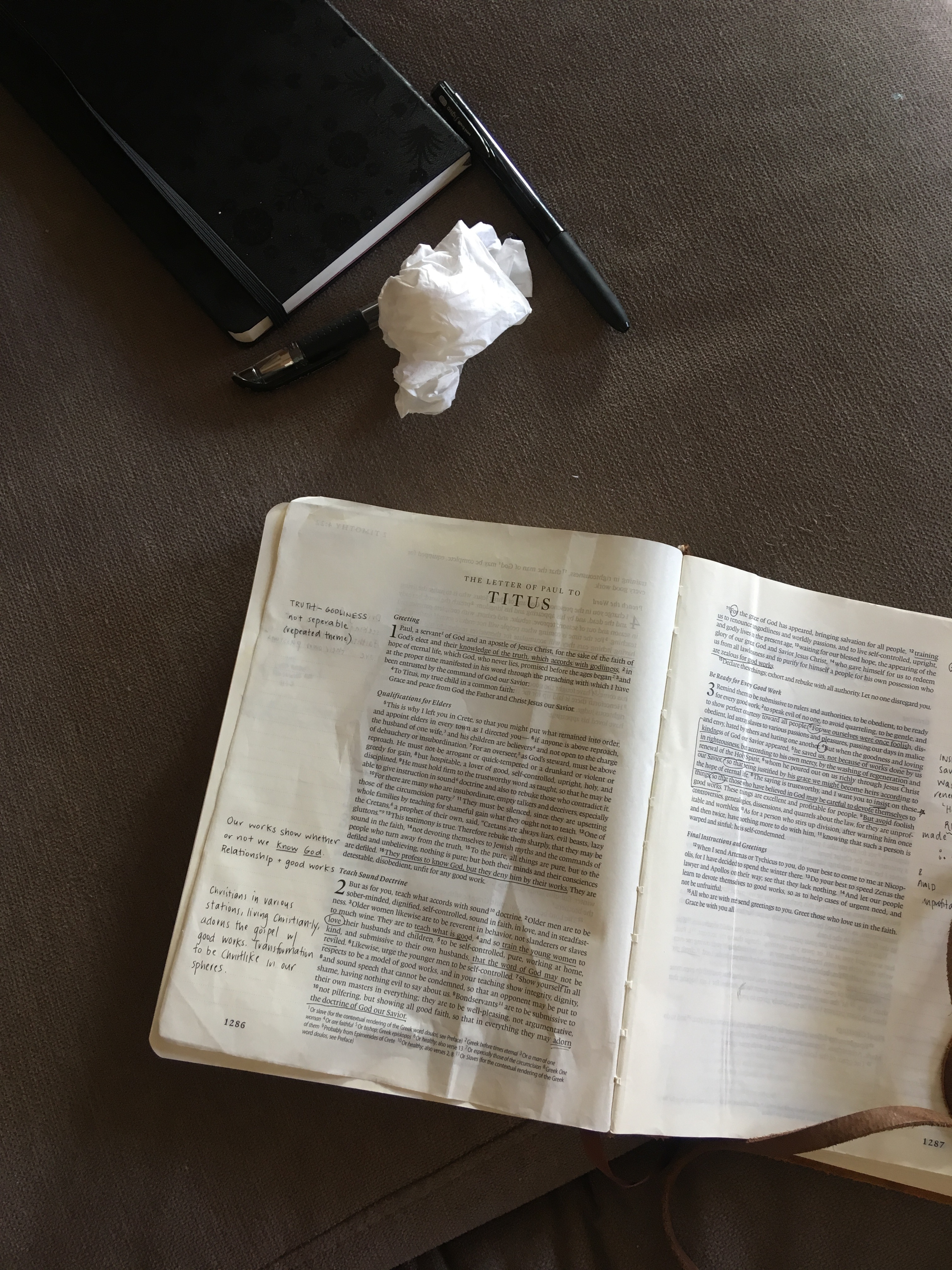 I prepped to teach on Titus last Sunday. I thought long the week before about the relationship between life and doctrine, and personally, about my calling as a woman and mom in the home a la Titus 2. I was reminded about the goodness of my work in loving my family.
It turns out Sunday morning had us waking up to sick kids and me texting that I’d have to forgo church responsibilities to stay home. Funny how God did that.
See, if you ever want evidence of my feeble faith, send me a sick baby. Give it a few nights and you’ll hear my sleep-deprived, “For what purpose God??” (Read: “Whyyyyyy?”) And it isn’t wholly my grumpiness speaking here. I actually feel justifiably upset about the seeming meaninglessness and inefficiency of these small trials.
I’ve been sitting in Ephesians 1 all week, savoring glorious truths a few words at a time. (Which, incidentally may be partly due to the fact that, in my sleepy haze, I can only hold a few words at a time.) After a night of little faith, as I wondered what practical good could come out of my sleep-deprivation, God answered through these words— that we should be holy and blameless before him.
He spoke to me of my being chosen in Christ before the foundation of the world for this reason (Eph. 1:3-4). He reminded me of his commitment to work all things to my good and his purposes— to my conformity into the image of his Son. I had forgotten about that.
So I’ve been thinking about this being made more into Christlikeness. And I’ve been seeing that my why’s and search for productivity and purpose and usefulness in glorifying God often miss this vital ingredient, the aspect of what God is doing in me and the call to be like Christ.
In the (possibly false but sometimes helpful) “being” vs. “doing” dichotomy, I gravitate to the latter. I’ve always had the desire to be helpful. The fear of being useless and the desire to hear “well done” on something truly well-done and most of all from God, are deeply rooted in me.
Don’t get me wrong, I’ve always thought of “being” as important, and I thought I had the relationship between who we are and what we do pretty well sorted out. We act out of who we are. (Which is true.) God cares about the heart behind what we do. (Which is also true.) Therefore, (this is where I start veering), I need to be who I’m supposed to be so I can do what I’m supposed to do to God’s glory without being disingenuous. I’ve never doubted the importance of being made more like Christ, but the fundamental orientation, the driving heart motive, usually leans “so I can do more, or right, or better.”
Years ago, as a teenager, I remember telling a mentor about my deep fear that God won’t use me. He gently push backed, with grace I didn’t understand at the time, maybe that isn’t the main thing. Evidently, I still need this pushback, and received it in part last week through a powerful article on mental health by Alan Noble. In it he writes,
Usefulness is the sole criterion for the World, the Flesh, or the Devil. But you have no use value to God. You can’t. There is nothing He needs. You can’t cease being useful to God because you were never useful to begin with. That’s simply not why He created you and why He continues to sustain your being in the world. It was gratuitous, prodigal. He made us just because He loves us and for His own good pleasure. Every other reason to live demands that you remain useful, and one day your use will run out. But not so with God. To God, your existence in His universe is an act of creation, and it remains good as creation even in its fallen state.
We were made for God’s pleasure, not his use. He made us because he loves us, because he is good, because it pleased him. Even more, according to Ephesians 1:12, he redeems us and makes us his “that we who were the first to hope in Christ might to the praise of his glory.” Here Paul doesn’t write that we might do things to the praise of his glory (though certainly we do). More fundamentally, we are made to be to the praise of his glory. And this isn’t a command, but a statement here. God has come through great lengths to make us his because his intent is to glorify himself through what he does for and in us.
As image-bearers, we give evidence to his “prodigal love”, his powerful sustenance, his wonderful creativity, and more. As those being recreated into Christ’s image, we give evidence to his wondrous grace, his redeeming love, his infinite patience, his holy nature, and more. Who we are brings glory to him because what he is doing in us is glorious.
Ephesians 1, along with thoughts about our lack of use value to God, is simmering in my heart. God’s truths are an elixir for my anxious doing and as the Spirit continues to stir, I am catching the waft of healing soul-questions. Questions arising from the suspicion that I have often headed in the wrong direction with my “why’s”. Questions that reorient and help my heart to rest, that comfort, that have me praising God for his other-worldly wisdom.
For others who seek God’s glory but have trouble working from a place of peace, other restless doers like me, perhaps some of these questions would serve you as well.
Dear beloved, chosen in Christ from before the foundations of the world, redeemed for the praise of his glorious grace.
…What if you glorify God not just by what you do, but by virtue of who you are?
…What if the most glorious display of his goodness is not in our works, but his workmanship— us (Eph. 2:10)?
…What if we believed that just as Adam and Eve were the glorious apex of creation, we believe our being remade into the image of Christ (us, the church) is the glorious apex of the new heavens and earth?
…What if, when the day of Christ comes, the most God-glorifying work done in the world is not done by man, but God himself? What if the most God-glorifying work done in our lives is that which is being done in us?
…What if we believed with God that this work was good? (Phil. 1:6)
…What if God desires to draw attention to his wisdom, power, grace, and kindness most chiefly in Christ’s work done for us? (Eph. 1:4-10, 2:7)
…What if the biggest question isn’t what you would do for God but who he himself is making you to be to the praise of his glory?
-
 She would’ve napped for longer if I put her down in the crib, but I let her fall asleep on me because I love the feel of her in my arms. “You love this age,” my sister said to me recently— I really do. I love the way she still fits, her chubby thighs, and her soft baby breaths.
Baby snuggles are one of God’s answers lately to my existential angst.
“There is godly way to pursue things in the world and sinful ways to pursue spiritual things,” one of my professors said once. His words worked to shift something in my foundations, my concrete paradigms of the Christian life. They also point a finger at the vestiges of sin in me. In particular, a sinful way I try to pursue the Kingdom is to demand direct ties between my good works— whether through writing, at church, or in my home— and visible fruit. This is part of my bent as a big picture person (NF, for you Myerrs-Brigg-ers) who is always looking for connections. It’s why I write, and read, and think. But in the everyday, it means I often try to find peace and purpose through productivity. The measures are ostensibly spiritual— but the trap is that in seeking to justify my work through results, I am seeking to do sacred work while still walking by sight.
This desire to know without a doubt that I am accomplishing all I should do, and in everything doing things of eternal consequence, bears bad fruit. I’m prone to fretfulness over my own effectiveness, to perfectionism in what I do, to anxiety over wasted time, and an overall inability to rest. It also leads to, “Why-do-I-feel-so-tired-and-like-I-didn’t-do-all-I-should-but-it’s-not-like-I-wasted-time-today-so-did-I-make-the-right-choices?” and the aforementioned existential angst.
Motherhood has been sanctifying here. In part, it has limited my ability to spend time on explicitly “spiritual” work so that I need to trust God’s words on the sacredness of secular work. It has led to more exhaustingly “unproductive” days than one. But it also has been the sphere of life I’ve received gracious correction through the comfort of God’s good gifts.
As a seeker of meaning, I find myself circling back to Ecclesiastes every so often, and I have been camping here recently. Here the Old Testament Preacher grapples with the question of life’s purpose. He cannot find it in pleasure, wealth, wisdom, or toil and so again and again speaks of life feeling meaningless, “a chasing after the wind.” His answer ultimately though, is not to deny pleasure, wealth, wisdom, or work. Rather, he declares:
He has made everything beautiful in its time. Also, he has put eternity into man’s heart, yet so that he cannot find out what God has done from the beginning to the end. I perceived that there is nothing better for them than to be joyful and to do good as long as they live; also that everyone should eat and drink and take pleasure in all his toil—this is God’s gift to man. I perceived that whatever God does endures forever; nothing can be added to it, nor anything taken from it. God has done it, so that people fear before him. I perceived that there is nothing better for them than to be joyful and to do good as long as they live; also that everyone should eat and drink and take pleasure in all his toil—this is God’s gift to man. (Eccl. 3:11-12)
The reason the Preacher cannot find meaning in the temporal is not because it is bad, but because on every side he pushes against mystery. As eternal beings, our hearts grasp at the strings to connect all we do to the eternal. But in our finitude, we cannot begin to trace them all. Thus, the Preacher’s answer for my longing to find my security and justify my life through my works is worship. God alone, he says, does work that endures forever. We cannot add or take away from it, we cannot even fathom the sum of it. And so, we fear him who does eternal things. And our role here? We are called to “be joyful and do good” as long as we live, and to receive from God the gifts he gives.
Eric Liddell, missionary and Olympian running, said once that when he did, he felt God’s pleasure. In contrast, his competitor is depicted in the movie Chariots of Fire as describing his races as “10 lonely seconds to justify my existence.” The Christian, justified by Christ and delighted by the Father, does not need to justify her own existence. We work, yes, but as a gift. And we receive all he has to give during our few days under the sun, trusting that he who is over the sun is building something that lasts through the good we do.
As we surrender our self-justification, God gives us contentment and the ability to enjoy his gifts and our toil:
Behold, what I have seen to be good and fitting is to eat and drink andfind enjoyment in all the toil with which one toils under the sun the few days of his life that God has given him, for this is his lot. Everyone also to whom God has given wealth and possessions and power to enjoy them, and to accept his lot and rejoice in his toil—this is the gift of God. For he will not much remember the days of his life because God keeps him occupied with joy in his heart.
Through the Scriptures, God dismantles my idolatry of productivity and success, silencing the voices of accusation and judgement of a twisted conscience that does not allow for rest or mistakes or a sense of God’s pleasure. I can delight in the things of this world— my work, my children— and receive the contentment I feel in loving and serving them as good. As I learn to walk by faith, to surrender my need to understand and justify my own existence on my own terms, I rest with the little one snuggling in my arms. I receive this rest— and her— as given out of an overflow of God’s love.
We celebrated a birthday in our family this week, it flew by like a highway mile marker, giving testimony that the years indeed are a breath. We each shared why we were thankful for the birthday girl. We enjoyed a meal at one of her favorite restaurants. We delighted in each other. Food and drink, family, presents, and a sudden declaration of “BEST DAY OF THE YEAR!” by one being honored— all gifts. All from God who “keeps us occupied with joy in our hearts.”
Yes, the years are a but a breath, but they are so filled lavishly with good things by the unspeakably good God of infinite worth, power, and wisdom. Knowing this, I will work and rest today, and in worship, breathe it in.
-

I need Thee, O I need Thee,
Every hour I need Thee!
O bless me now, Savior, I come to Thee.
– I Need Thee Every HourThe girls are in school and we are in a new season. While I’m not exactly swimming in free time, I’ve been afforded a bit of mental space and time (albeit with toddler and baby). But with this gift of margin, I have found myself anxious, even paralyzed at times. There’s so much I want to do but not enough time to do it all. How do I choose what gets done and what doesn’t? Where should start?
This anxiety isn’t new for me. A refrain in my tenure as a stay-at-home mom has been the struggle of feeling like I’m not accomplishing all I should. Some of my problem is practical— I need more realistic goals and expectations. Some of it is spiritual— the ongoing struggle against perfectionism and asceticism.
God is speaking to these things even now. I have been coming to “aha!” moments with gladness, then stopping and realizing I’ve had these “revelations” before and have either forgotten or not thought to apply them this time.
In Psalm 71:3, the singer cries out: Be to me a rock of refuge, to which I may continually come; you have given the command to save me, for you are my rock and my fortress.
The continually is a comfort for forgetters like me.
In education, there are different types of curriculum. The “mastery” ones stay on one topic and move one once the learner has “mastered” it. “Spiral” ones spread out one topic over time, progressively bringing the learner to a different level each time a topic is repeated. I am hoping that the reiterations of truth God is speaking to me now are going deeper than before. That God is patiently weaving multi-spiral lessons into my life and I’m just seeing one strand of color resurface for now. Or maybe I’m just giving a chance to learn what I never mastered. Whatever the case, I am glad that God is not upset that I need him to repeat himself. Again.
Continually.
Do you need him to speak to you words of grace and truth today? Are you frustrated that you still need help? Still need comfort? Still need healing? Still need correction? Do you imagine he is as frustrated as you are? Picture the most patient and kind teacher you know. Times that by 1000 and you’ll start to get a clearer picture of what God is like.
Beloved, take refuge in your infinitely gracious God today. Our fleeing to God for help is not a one and done thing. As our Father, he delights in our coming to him. As Lord, he receives glory as he gives the command to save. He does not tire of repeating himself and will not rebuke you as you come to him once more.
-
Just from Jesus simply taking life and rest and joy and peace. I stand in my kitchen, listening as the words fall and flow like Isaiah’s waters in the wilderness. “The burning sand shall become a pool, and the thirsty ground springs of water”, he prophesied.
God knows I am thirsty.
And, just from Jesus simply taking— this is living, gospel water.
—
My default, a combination of temperament, experience, and the general human condition, is to approach the Christian life ready to do, to strive, to work. I am not a Deist; I do not believe God just wound the clock and left us to run. But I can live as if I am the main force in my life, God having jumpstarted it by grace.We sang Tis So Sweet at our wedding, hands raised, declaring God’s faithfulness and our need. These days, the old hymn ministers to me again. “Just from Jesus simply taking” does not come naturally, and has not been my posture as of late.
Just from Jesus simply taking— can it really be that simple? In the midst of all that is going on in and around me, life and rest, and joy, and peace are mine to simply receive? As I meditate on these words, the weight in my heart shifts a bit.
If we have eyes to see them, to listen for it, we will find Scripture replete with God’s divine invitation to simply take.
I came that they may have life and have it abundantly (Jn. 10:10).
Come to me, all who labor and are heavy laden, and I will give you rest (Mt 11:28).
Ask, and you will receive, that your joy may be full (Jn. 16:24).
Peace I leave with you; my peace I give to you. Not as the world gives do I give to you. Let not your hearts be troubled, neither let them be afraid (Jn. 14:27).
Life. Rest. Joy. And peace. These are mine and yours for the taking. Not as mighty conquerors claiming a prize. No, not as the world gives does he give. Not by earning. Not with strings attached, only if you’re beautiful and smart and strong and good enough.
This is Jesus who gives. Precious Jesus, who said of his own body and blood, offered to sinners— Take, eat and drink. To those with no hope of making it on our own, he gave himself that we may freely receive what he has bought with his blood.
So come, weary ones, and find rest. Come depressed and despairing, find joy. Come, anxious and obsessive worriers, find peace. Come broken and dying, and find life. Take him at his word and rest on his promise. In simple faith plunge beneath the healing cleansing flood, and find grace to trust him more.
-

She sings as she suckles. The notes rise and fall and I feel her song on my chest. This moment is a gift, a divine yes.
…
The last month hasn’t been the easiest. We are walking on while waiting on many fronts. Some are shorter-term needs, others are distant hopes. We are praying for prodigals and struggling saints, for suffering friends and hurting ministries, for the faith of our children and our own sanctification. In my grief and anxiety, I have wondered if he truly sees, if he will really answer. God, help me believe that you answer prayers, I weakly offered just last week.
Now, listening to my baby breathe, I think about how each exhale is a resounding testimony that he indeed hears.
During pregnancy, I prayed almost daily— God, please let this baby live.
After miscarriage, after Jeff dreamt we had another little boy and girl— God, please let this be prophetic.
As newly married— God, would you grow our family?
When we dated— God, please confirm our steps.
As a single woman— God, you know my desires.
Yes, yes, yes, yes, and yes, he said. And this is just one trail of petitions.
If I reach for a different thread, I find countless others wrapped up in this very moment. There’s confirmation about where to serve, the home I am sitting in, the faith to follow. There’s the silence right now—the gift of rest as Jeff takes out the big kids, and the notable absence of the voices of shame and condemnation, once constant companions. I have a steady sense of purpose, a will to live, an assurance that I belong to God. This hasn’t always been the case.
There have been plenty of no’s and the answers have not always come as quickly as I hoped. But I pleaded in years past— God, make yourself real to me. Steadily and surely, he has. The gift of our fourth child and the faith I have as I hold her now is but a small sampling of how.
…
From the lips of my baby he has ordained praise, the gift of unveiling and an invitation to remembrance. Do you really answer prayer? Her song is the gentlest rebuke for my forgetfulness, a soft yet strong word: See here my yeses.
-
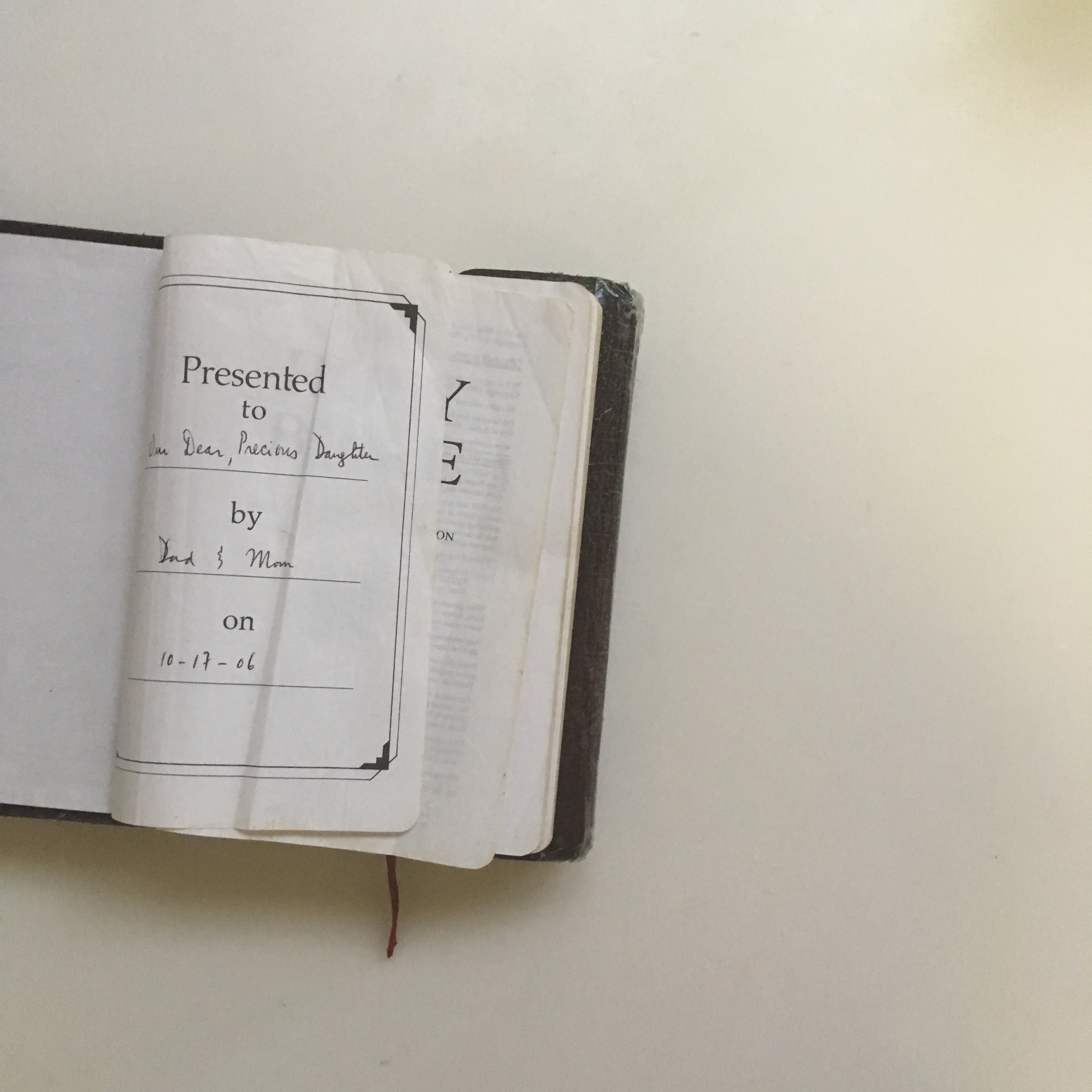
My parents gave me this Bible as I started ministry after college. It travelled all over the world with me, sitting open during meet-ups and quiet times. It is highlighted and underlined with remembrances of living words shedding light on my heart. And while it’s been shelved for some years (I switched translations), I pulled it out recently for Bible reading with the kids.
There’s nothing magical about an old Bible, but it is sweet to think that God knew as I read, prayed, fretted over my future with it, I’d one day be using it to speak his words to my own children.
Our family has recently started reading the Bible together daily. We’ve probably only been 50/50 (or 75/25) in terms of consistency, but it’s been really good. So while we’re just getting into the grind of it, I thought I’d share some of my preliminary thoughts for others thinking about cultivating the same discipline.
It doesn’t have to be complicated.
We read one chapter in the OT and one in the NT per reading (right now Psalms and the Gospels). We try to read in the morning over breakfast and at night when the kids are ready for bed. We’re not always consistent, especially at night, but having a simple routine keeps it from feeling too daunting. For us, 5-10 minutes a reading means 10-20 minutes a day. We’re not coming with lesson plans (though we have had good conversations), just listening to God’s Word together and answering questions as they come up.
It’s a great way to serve my children while caring for my soul.
Last month, I talked to a friend, a mom and missionary, who recently sustained an ankle injury. When I asked her how she’d have time to focus on her recovery, she told me PT told her to include her kids in her therapy exercises. Right now, our children love it when we read to them. They love spending focused time with us (sometimes when we’d rather them not!) and will take every moment with us they can get. As much as I may feel too busy or tired, I want to make the most of this time while their hearts are still soft to God’s word and to me. And in this season where alone time is hard to come by, God’s been refreshing my heart through these morning and night bookends.
It’s about tasting and seeing together that God is good.
One way to make readings feel boring for kids is to automatically turn the passages into ways to get them to behave. While there are times for correction and instruction, not every Bible reading should feel this way. More than needing a moral compass, our children need (and want!) to know the living God through his wondrous deeds. When we read together, we are simply opening up the Word of God to discover together how amazing, captivating, powerful, holy, beautiful, and wonderful he is. And truly he is.
It’s not impossible.
I remember reading about families doing family devotions and thinking it was a good idea— in theory. I pictured something that felt formal and forced. I pictured families sitting still, being serious, and basically not looking like ours. (For some context, we have trouble getting the kids to stay seated at the table for meals.) It turns out our readings just look like our family having our usual time together– only instead of focusing our attention on a children’s book, game, or movie, we’re reading the Bible together. Sometimes the kids will roll around in bed, stare off blankly into space, or ask a completely unrelated question. But more often than not, they are listening. And even if they don’t remember everything we read, they are learning through practice that God’s word is worth our time and attention.
Lastly, we need to believe it is worth it it.
Though it’s not impossible, consistent Bible reading does take effort. But it takes more than just determination and grit. When I get to the heart of it, the biggest reason I often choose not to spend time in God’s word is not busyness or lack of discipline, but unbelief. I push it aside because I’m not sure he’ll speak to me. I’m not convinced that he’ll speak what I need to hear or meet me in my need.
So I need faith. Faith that God has something to say to my family, that he holds the words of life. Faith that as pressing as everything else seems, we won’t regret stopping to hear from him. Faith that above all else, we need him, his grace, and his truth. And faith that if his Word falls on good soil today, it will bear a harvest, 30, 60, 100-fold in due time.
The law of the Lord is perfect, refreshing the soul.
The statutes of the Lord are trustworthy, making wise the simple.
The precepts of the Lord are right, giving joy to the heart.
The commands of the Lord are radiant, giving light to the eyes.
Psalm 19:7-8 (NIV)
-
Subscribe
Subscribed
Already have a WordPress.com account? Log in now.
 Keeping Heart